The best YouTube Shorts scrapers, ranked
Ten tools ranked, and the problem underneath all of them: YouTube's own API has no idea which of its videos are Shorts, and cannot tell you.
Before any question about which tool is best, there is a problem specific to this platform that most round-ups skip, and skipping it is why people end up with a dataset that is quietly wrong. YouTube has a first class public API, it is free, and it cannot tell you which of its videos are Shorts. There is no field for it. There has never been a field for it.
Our articles are still written by humans!
Get human written articles in your Google feed.
Why nothing can reliably tell you what a Short is

YouTube's own rule is precise. Since 15 October 2024, a video uploaded with a square or vertical aspect ratio, up to three minutes long, is categorised as a Short. Before that date the limit was sixty seconds, and videos uploaded before the change keep the classification they had, so the rule that applies to any given video depends on when it went up.
Now put that beside what the API returns. `contentDetails.duration` gives you the length in ISO 8601. `snippet.publishedAt` gives you the date. And `contentDetails.dimension` sounds like the field you need until you read it, at which point it turns out to mean 2D or 3D. Aspect ratio is not in the resource. The API therefore holds two of the three inputs to YouTube's own rule and cannot evaluate it.
Every Shorts dataset you will ever be sold is the output of a guess. The only question worth asking a vendor is which guess, and almost none of them say.
In practice there are three guesses in circulation, and they fail differently. Filtering on duration alone is the common one and it over collects badly, because a forty second landscape clip from a long form channel is not a Short and looks exactly like one in the data. Reading the thumbnail dimensions gets you closer and costs an extra request per video. Requesting youtube.com/shorts/ plus the video id and seeing whether it serves or redirects to the watch page is the reliable test, and it is a page fetch rather than an API call, which is to say it is scraping.
That last point is the quiet reason this market exists at all on YouTube, where unlike Instagram and TikTok there is a perfectly good official API. You are not usually buying access to data the API withholds. You are buying somebody else's answer to a classification question the API declines to answer.
What the terms say, briefly
YouTube's Terms of Service are unusually clear here. You are not permitted to access the service by automated means, "such as robots, spider networks or content scraping technologies", except as a public search engine following robots.txt, with prior written permission, or as applicable law permits. There is no ambiguity to litigate and no equivalent of the Meta case to lean on, which is the exception rather than the rule: the same clause on every other platform, quoted whole, carries qualifiers that change the answer.
The practical difference from the other two platforms is that here there is a sanctioned alternative that actually works for most use cases. On Instagram and TikTok the official route is closed to you by design, which is covered in the Instagram ranking and the TikTok ranking. On YouTube it is open, free and good, and the reason to step outside it is quota or the Shorts problem above, not access. That changes the calculation, and it is why the free official API is ranked first here and unranked in the other two articles.
What ranked means here
- Does it know what a Short is, and will it say how it decided?
- Does somebody else run the part that breaks?
- Can you price the job before running it? Per result and per credit can be multiplied. Per gigabyte cannot.
- What is the ceiling? On this platform the binding constraint is usually a quota rather than a bill.
- Can you leave with your data?
| Rank | Tool | What you pay for | Where it stops |
|---|---|---|---|
| 1 | YouTube Data API v3 | Nothing | 100 searches a day, and no idea what a Short is |
| 2 | Apify | Per result, $2.40 per 1,000 videos | Third party actor, so the maintainer is not Apify |
| 3 | ScrapeCreators | Per credit, credits never expire | Small team behind a lot of surface |
| 4 | Supadata | Per request, transcripts first | Not a metrics tool, and does not pretend to be |
| 5 | Bright Data | Per record, plus proxy plans | Enterprise motion past the free tier |
| 6 | EnsembleData | Monthly plan, daily unit cap | Cannot burst past today's cap |
| 7 | yt-dlp | Nothing, it is free software | Your IP, your terms problem, and it downloads media |
| 8 | SearchApi | Per successful search | A SERP house, YouTube is a side engine |
| 9 | Oxylabs | Per result or per GB, enterprise | Sold for volume you probably do not have |
| 10 | Decodo | Per request or per GB | Proxy house first, scraper second |
1. The YouTube Data API v3
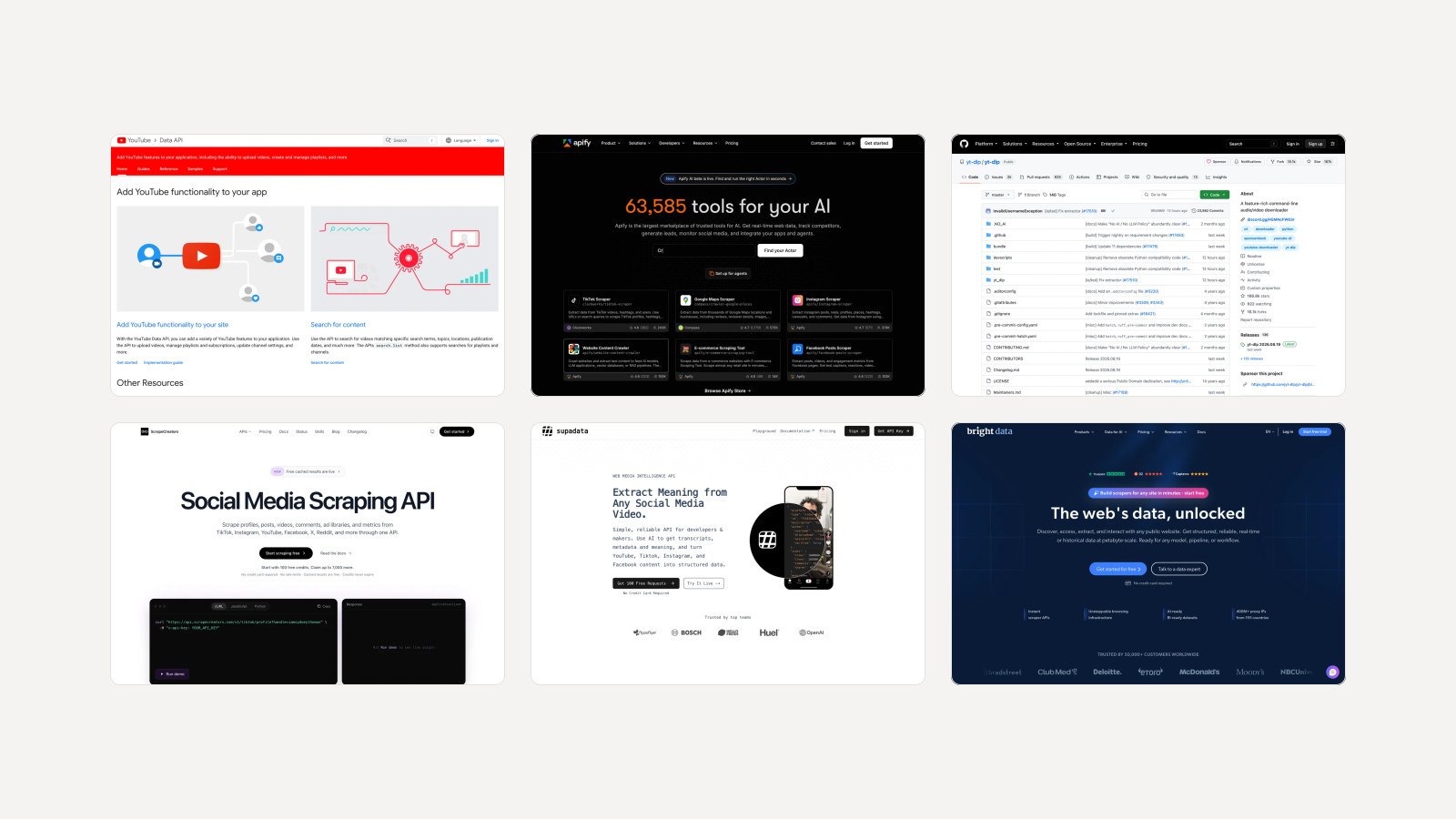
It is free, it is stable, it is documented, it is supported, and using it does not put you outside anybody's terms. Start here, always, and only leave when you hit something it cannot do. On this platform that advice is real rather than dutiful, because unlike Instagram and TikTok the official API genuinely reaches other people's public content: channels, videos, playlists, statistics and search.
The two limits are worth knowing precisely, because both surprise people. The first is the Shorts problem above, which no amount of quota fixes. The second is the quota shape, which is not what most articles say it is: as documented today, a project gets a default allocation of 100 search.list calls a day, 100 videos.insert calls a day, and 10,000 units a day across everything else, with search.list sitting in its own bucket at one unit per call. Reading resources costs a unit each, writes cost fifty.
So the ceiling that stops you is a hundred searches a day, and it stops you fast. Enumerating a category by keyword is a search problem, and a hundred calls is perhaps a few thousand results before midnight Pacific. Fetching known video ids, by contrast, is cheap: ten thousand units covers a great deal of videos.list. If you can turn your question into a list of channels rather than a search, the official API will carry a surprising amount of work and cost nothing.
2. Apify

The YouTube Scraper maintained by Streamers is the only paid tool in this comparison that treats Shorts as a first class thing rather than a filter you apply afterwards. Its input lets you set separate limits for regular videos, Shorts and streams, which means you can ask for a channel's Shorts and exclude everything else by setting the other limits to zero. Given the section above, that is a real feature and not a checkbox.
Pricing is $2.40 per 1,000 videos, pay per result, which is the meter you want because a job over eighty channels at fifty Shorts each is a multiplication you can do before you spend anything. It is second rather than first only because it costs money and the official API does not, and because this actor is a third party one rather than Apify's own, so the maintenance is somebody's ongoing choice.
3. ScrapeCreators

If you are writing the code and want one API key across YouTube, TikTok, Instagram and thirty odd more, this is the pick. One x-api-key header, no account level rate limit, 100 free credits with up to 7,000 more claimable, credits that never expire, and cache hits billed at nothing, which on a project that re-fetches the same channels weekly is a larger saving than it sounds.
Third rather than higher for two reasons. The team is small enough that its own FAQ carries the question "Are you a one-man company?", and on YouTube specifically it is competing with a free first party API that is better documented than anything a startup can maintain. Its case is cross platform consistency: if you are already pulling TikTok and Instagram through it, adding YouTube costs you no new integration, and that is worth more than the per call price difference.
4. Supadata, if the transcript is the point

Supadata turns video into text across YouTube, TikTok, Instagram and Facebook: transcripts, metadata and structured output, a hundred free requests, no card. It is fourth on a scraper ranking and it would be first on a different one, because a large share of people who set out to scrape Shorts want to know what was said and have not yet worked out that view counts will never tell them.
The distinction is worth being blunt about. Metrics tell you which Short worked. Transcripts tell you why, and on a format where the first three seconds decide everything, why is the only half you can act on. If you are studying hooks in order to write your own, the transcript of forty Shorts beats the engagement table of four thousand, and it is a cheaper afternoon. The same argument, applied to writing rather than analysis, is in ChatGPT prompts for Instagram Reels.
5 and 6. Bright Data and EnsembleData

Both are strong products ranked mid table for the same structural reason: they are excellent general purpose social data platforms on a platform that already has a good free API. Bright Data brings scale, prebuilt datasets, a free monthly record allowance and a compliance function you can actually talk to, and if you need millions of rows with an invoice your finance team recognises it belongs first. EnsembleData brings a legible unit model and a daily cap that suits a steady trickle and suits a backfill badly.

Neither of them, and this applies to everything from here down, publishes how it decides a video is a Short. That is not a scandal and it is the question to put in the first support email, because the answer determines whether your dataset quietly contains every short landscape clip on the channel.
7. yt-dlp

yt-dlp is the most capable piece of software on this page by a distance, it is free, it is under the Unlicense, and it has 187,000 stars and a release most months. For pulling metadata about a specific list of videos onto your own machine, its `--dump-json` will give you a richer object than the official API returns, without downloading a byte of video, and it will do it for free.
It is seventh because of what this list is ranking. It is a downloader, so the default path fetches media rather than data, and media is where the terms question gets sharpest and the disk usage gets silly. There is no proxy rotation, no queue and no status page, so your own IP address is the whole infrastructure. And the project documents how to use it, not whether you should: the README is entirely technical, which leaves the terms of service question, quoted above and not ambiguous, sitting squarely with you.
8, 9 and 10. SearchApi, Oxylabs and Decodo

SearchApi has a YouTube engine and it is decent, and its home page is about Google SERPs, which tells you where the attention goes. Its per successful search model is genuinely nice, but you are buying a side product from a company whose main business is elsewhere, and on YouTube that side product is competing with a free official API that does the same job.
Oxylabs and Decodo are proxy businesses with scraping products over the top. Both are very good at the thing they are actually for, which is unblocking a scraper you already wrote. Neither is the right first purchase for somebody who has not written one, and on the platform with the best free API of the three, that gap is at its widest.
The pattern across all three platforms
Writing these three rankings together made one thing obvious that is invisible from inside any one of them. The tools are largely the same companies. What differs completely is what you are buying from them.
| Platform | What the official API gives you | So what are you buying? |
|---|---|---|
| Only accounts that authorised your app | Access, because there is no official route | |
| TikTok | Research API, academic and non-commercial only | Access, because you are not eligible |
| YouTube | Public search, videos, channels, free | Quota, and a classification the API refuses to make |
That is why the advice inverts here. On Instagram and TikTok the first question is which vendor to trust. On YouTube the first question is whether you need a vendor at all, and for a lot of readers the honest answer is a weekend with the official API, a list of channel ids and a spreadsheet.
Before you buy, check whether this is a once
There are good reasons to be here: building a creator shortlist you will actually contact, sizing a niche, studying a format before committing to it, or feeding a product that genuinely needs the data. For all of them, the official API plus an afternoon, or one of the top three plus a free tier, will settle it.
And there is the reason nobody says out loud, which is that the channel has stalled and research feels like progress. Six hundred rows of somebody else's Shorts performance is a satisfying afternoon and it puts nothing on your channel on Thursday. If that is nearer the truth, the more useful next step is what a small business should post about, and if the real problem is that whole weeks pass with nothing published, that is a different category of tool and it is compared in the best AI social media tools.
Frequently asked questions
Can the YouTube API tell me if a video is a Short?
No. The videos resource has no field for it. You get duration and publication date, and the dimension field means 2D or 3D rather than portrait or landscape, so the API holds two of the three inputs to YouTube's own rule and cannot apply it. Every Shorts dataset is therefore the result of an inference, usually on duration alone.
How do you reliably detect a YouTube Short?
Request youtube.com/shorts/ plus the video id and see whether it serves the page or redirects to the watch page. That is the reliable test and it is a page fetch rather than an API call. Filtering on duration alone over collects, because a short landscape clip is not a Short, and any correct rule also has to account for the sixty second limit that applied before 15 October 2024.
What is the YouTube Data API quota?
As documented in August 2026, a project gets a default allocation of 100 search.list calls a day, 100 videos.insert calls a day, and 10,000 units a day across all other endpoints, with reads costing one unit and writes fifty. The hundred searches, not the unit budget, is what stops most projects. Quotas reset at midnight Pacific.
Is scraping YouTube legal?
YouTube's terms prohibit accessing the service by automated means such as robots, spiders or content scraping technologies, except for public search engines following robots.txt, with prior written permission, or as applicable law permits. That is a contract question and is separate from whether any law is broken. Because the official API is free and reaches public content, the sanctioned route is a real option here in a way it is not on Instagram or TikTok.
What is the best free YouTube Shorts scraper?
The official YouTube Data API for metadata, since it is free, supported and stays inside the terms, with the Shorts caveat above. yt-dlp if you need richer per video data and can accept that your own IP makes every request and that it is a downloader by design.
How do I get transcripts of YouTube Shorts?
A transcript API such as Supadata, rather than a general scraper. If you are studying hooks and openings, transcripts answer the question that view counts cannot, and forty transcripts will usually teach you more than four thousand rows of engagement data.
How we researched this
- The ten are the tools people actually reach for: the official API first, then the general scraping platforms with a YouTube product, the open source downloader everybody eventually finds, and the transcript specialists. Every home page here was captured on 25 August 2026, and the API reference, quota table and Shorts help pages cited below were read by hand the same day.
- The Shorts detection problem in the second section is the reason this article exists as a separate piece rather than a paragraph in a general YouTube round-up. It was checked directly against the videos resource reference and the Shorts help page rather than taken from other articles, most of which still quote the sixty second rule that stopped being current in October 2024.
- The rank order answers one question: which of these gets Shorts data into your hands, correctly labelled as Shorts, at a price you can work out in advance and without you maintaining the fragile part. A tool can be excellent and rank low because it answers a different question, and two here do.
- We did not run all ten over the same channel on the same day and diff the output. What is compared is what each vendor publishes, what the platform's own documentation and terms say, and what shape the failure takes. Where a specific capability is claimed below, such as separating Shorts from long form, it was read off the tool's own page on the date given.
Sources