The best time to post on TikTok: four studies, eleven million posts, and one window they all agree on
Buffer says Saturday is the best day. Sprout Social says do not post on Saturday. Metricool says Saturday is the quietest day of the week. Four large studies contradict each other on every single day, one slot survives all four, and TikTok's own description of the For You feed never mentions posting time at all.

Post on Friday between 5 and 8 p.m. in your audience's local time. That is not the loudest answer on this topic, it is the only one that survives reading all four of the large public studies instead of one of them. Buffer measured 7.1 million posts, Sprout Social measured about 2 billion engagements, Metricool measured 2.3 million and RecurPost measured over 2 million, and on every other day of the week at least one of them contradicts at least one other. Saturday is Buffer's single best day. Sprout Social tells you not to post on Saturday. Metricool calls Saturday the quietest day it measured. Those are three honest reads of large datasets reaching three incompatible conclusions about one day, and no guide that quotes only one of them can tell you that.
Our articles are still written by humans!
Get human written articles in your Google feed.
RecurPost's best time to post on TikTok, day by day
RecurPost puts its three strongest TikTok windows at Monday 1 PM, Friday 8 PM and Saturday 8 PM, US Eastern time. That is its own summary, on a page it updated on 23 August 2026 and describes as backed by more than 2 million scheduled posts. Its day by day table is below, unchanged, next to the window where all four studies in this article overlap.
The three strongest posting windows on TikTok in 2026 are Monday at 1 PM, Friday at 8 PM, and Saturday at 8 PM EST.
| Day | RecurPost (EST) | Where all four studies overlap |
|---|---|---|
| Monday | 10 AM, 1 PM, 9 PM | 1 p.m., with a second cluster after 7 p.m. |
| Tuesday | 12 AM, 1 PM, 4 PM | Nothing. The widest spread of the week |
| Wednesday | 9 AM, 11 AM, 9 PM | 7 to 9 p.m., three of the four |
| Thursday | 10 AM, 11 AM, 10 PM | Two answers: 1 p.m. or late evening |
| Friday | 10 AM, 5 PM, 8 PM | 5 to 8 p.m., all four |
| Saturday | 9 AM, 3 PM, 8 PM | 3 to 5 p.m., if you post at all |
| Sunday | 12 PM, 2 PM, 4 PM | Midday, 12 to 2 p.m. |
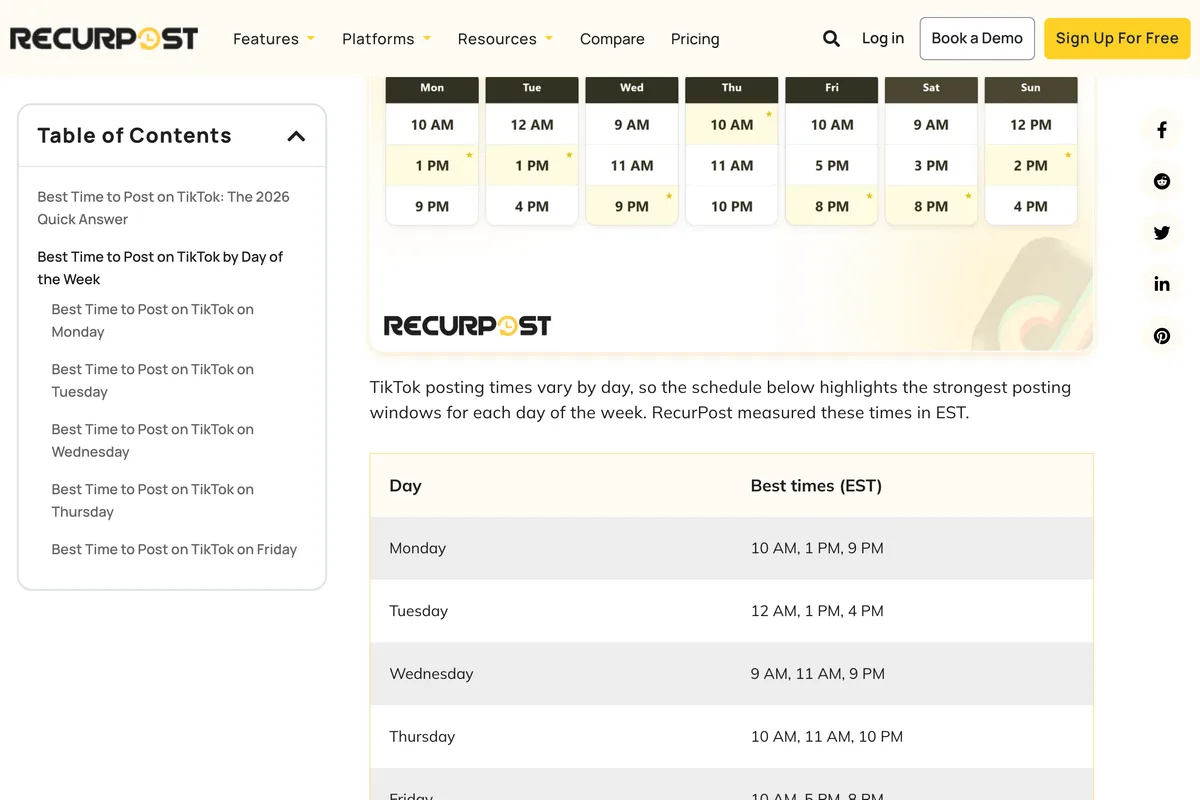
Two things on RecurPost's page change how to use its numbers, and most summaries of it leave both out. The first is the clock. The times are US Eastern, and for an audience outside the US RecurPost's own advice is to use them as local hours rather than convert them:
If the audience is local to another region, treat the EST hours as local hours (1 PM on a Monday in London for a UK audience) and confirm the shift with Follower Activity.
The second is where the times come from. RecurPost says they rest on the posts it has scheduled for customers, and in the next sentence that the timeline was mapped out by tracking global user engagement trends and algorithmic patterns. That is a blend, not a single measurement, which is one reason we weigh it below the other three.
Checked against the others, RecurPost's three headline windows do not fare equally. Friday 8 PM is the strongest of them: Buffer ranks 8 p.m. third on Friday and Metricool puts Friday's peak at 8 p.m. Monday 1 PM has Buffer behind it too, as Buffer's second best slot of the whole week. Saturday 8 PM is the weakest: Sprout Social says do not post on Saturday at all, and Metricool calls Saturday its quietest day. If you use one RecurPost window, use Friday's.
What the four studies actually found
Set the four side by side and the disagreement is not at the margins, it is structural. Buffer found its single strongest slot on Sunday at 9 a.m. and its weakest days in the middle of the week. Sprout Social found the opposite shape entirely: Tuesday through Thursday, 2 to 6 p.m., with the weekend written off as what it calls an algorithmic dead zone. Metricool put the peak of the entire week on Sunday at 8 p.m., eleven hours after Buffer's Sunday peak and on a day Sprout Social names as the worst of the seven. RecurPost landed on Friday and Saturday evenings around 8 p.m., which agrees with Metricool on the hour and with nobody on the day.
| Claim | Buffer, 7.1M posts | Sprout Social, ~2B engagements | Metricool, 2.31M posts | RecurPost, 2M+ posts |
|---|---|---|---|---|
| Best single slot | Sunday 9 a.m. | Tue to Thu, 2 to 6 p.m. | Sunday 8 p.m. | Mon 1 p.m., Fri 8 p.m., Sat 8 p.m. |
| Best day | Saturday | Tuesday, Wednesday, Thursday | Sunday | Friday and Saturday |
| Worst | Wednesday and Thursday | Saturday and Sunday, avoid | Saturday, quietest | 1 to 5 a.m. |
| Shape of the day | Evening, 6 to 11 p.m. | Afternoon, 2 to 6 p.m. | 6 to 8 p.m. | Evening, around 8 p.m. |
| Hours reported in | Audience local time | Audience local time | Audience local time | US Eastern |
Day by day, with the disagreement printed
Most people arriving here are not asking about the week, they are asking about one day, usually because they are about to post on it. So here is every day with our reading of where the four studies overlap in the second column, and each study's own published window in the four columns after it. That second column is the only figure in this article nobody measured, which is why the evidence for it sits on the same row: check our arithmetic rather than taking it.
| Day | Where they overlap | Buffer | Sprout Social | Metricool | RecurPost (ET) |
|---|---|---|---|---|---|
| Monday | 1 p.m., with a second cluster after 7 p.m. | 1 p.m., then 11 a.m., 8 a.m. | 3 to 5 p.m. | 8 p.m., then 7 p.m. | 10 a.m., 1 p.m., 9 p.m. |
| Tuesday | Nothing. The widest spread of the week | 6 a.m., then 10 p.m., 7 a.m. | 2 to 6 p.m. | 8 p.m., then 7 p.m. | 12 a.m., 1 p.m., 4 p.m. |
| Wednesday | 7 to 9 p.m., three of the four | 10 p.m., then 6 a.m., 9 p.m. | 1 to 8 p.m. | 7 to 8 p.m. | 9 a.m., 11 a.m., 9 p.m. |
| Thursday | Two answers: 1 p.m. or late evening | 1 p.m., then 10 p.m., 6 a.m. | 1 to 5 p.m. | 8 p.m., then 7 p.m. | 10 a.m., 11 a.m., 10 p.m. |
| Friday | 5 to 8 p.m., all four | 6 p.m., then 10 p.m., 8 p.m. | 3 to 5 p.m. | 8 p.m. | 10 a.m., 5 p.m., 8 p.m. |
| Saturday | 3 to 5 p.m., if you post at all | 5 p.m., then 4 and 3 p.m. Best day | Avoid posting | 7 p.m., then 6 p.m. Quietest day | 9 a.m., 3 p.m., 8 p.m. |
| Sunday | Midday, 12 to 2 p.m. | 9 a.m., then 1 p.m., 12 p.m. | Avoid posting. Worst day | 8 p.m. Peak of the week | 12 p.m., 2 p.m., 4 p.m. |
Wednesday, the day with the second best case
Wednesday is the most searched day of the week on this question and it has a genuinely defensible answer: 7 to 9 p.m. Buffer's top Wednesday slot is 10 p.m. with 9 p.m. third, Metricool puts it at 7 to 8 p.m., RecurPost has 9 p.m., and Sprout Social's Wednesday window is a wide 1 to 8 p.m. that contains the bottom of that range. Three of the four converge on the two hours after seven and the fourth does not exclude them. The complication worth knowing is that Buffer also names Wednesday as one of its two weakest days overall, so this is a good hour on a day one large study thinks you should not have chosen.
Tuesday, where the data falls apart
Tuesday has no answer and anyone who gives you one confidently has read a single study. Buffer's best Tuesday hour is 6 a.m. Metricool's is 8 p.m. Those are fourteen hours apart on the same day of the same week. Sprout Social and RecurPost both land in the afternoon, which is not either of the other two. If you have to post on a Tuesday, the afternoon is the least contested part of it, and that is the strongest sentence the evidence supports.
Monday, and the two peaks
Monday is the only day where two studies name the same hour independently: Buffer and RecurPost both put 1 p.m. at or near the top, and Buffer's Monday 1 p.m. is its second best slot of the entire week. Against that, Metricool and RecurPost both find a second peak after 7 p.m. So Monday genuinely has two windows rather than one, which is unusual and useful: early afternoon, or the evening after eight.
Thursday, split down the middle
Thursday splits into an early afternoon cluster and a late evening one. Buffer's best Thursday hour is 1 p.m. and Sprout Social's window is 1 to 5 p.m., so those two agree. Metricool says 8 p.m. and Buffer's second choice is 10 p.m., so those two agree with each other instead. Pick one and hold it rather than alternating, because the whole point of a slot is that an audience learns it.
Friday, the one everybody agrees on
This is the finding worth having. Buffer's top Friday hour is 6 p.m. with 8 p.m. third. Metricool says 8 p.m. RecurPost says 5 p.m. and 8 p.m. Sprout Social says 3 to 5 p.m., which touches the bottom of that band. Four studies, four methods, four datasets, and their Friday windows overlap in the same three hours. Nothing else in this article is that well supported, and if you only ever schedule one slot a week, this is the one the evidence actually earns.
Saturday, the day three studies fight over
Saturday is the clearest illustration of why this genre of article should be read sceptically. Buffer names it the best day of the week. Metricool names it the quietest. Sprout Social says do not post. If you post anyway, Buffer's 3 to 5 p.m. and RecurPost's 3 p.m. give you a mid afternoon window that two of the four support, and Metricool's 6 to 7 p.m. is close behind. What nobody can give you is confidence.

Sunday, best and worst at the same time
Sunday holds both Buffer's single strongest slot of the week, 9 a.m., and Metricool's, 8 p.m., and Sprout Social's verdict that it is the worst day of the seven. Two studies place their peak of the entire week on a day a third tells you to skip. The only part of Sunday with more than one study behind it is the middle: Buffer's second and third Sunday choices are 1 p.m. and noon, and RecurPost's are noon, 2 p.m. and 4 p.m. If you post on a Sunday, post at lunchtime.
What TikTok itself says, which is less than you would expect
TikTok publishes an explanation of how the For You feed recommends videos, and it names three kinds of signal: user interactions, meaning the videos you like, share, comment on and create; video information, meaning captions, sounds and hashtags; and device and account settings, meaning language, country and device type. Read that list again and notice what is not on it. Posting time is not a signal. Time of day is not a signal. Recency is not named as a signal. TikTok also states plainly that neither follower count nor a history of high performing videos is a direct factor in recommendations, which is a stronger claim than most platforms are willing to make about themselves.
What TikTok does say is that stronger indicators of interest carry more weight than weak ones, and the example it gives is whether somebody finishes a longer video from beginning to end. That is the sentence to build a strategy on. It means the system is reading completion, and completion is a property of the video, not of the hour you uploaded it. The four studies above are measuring when audiences happen to be awake and scrolling, which is real and worth using, but they are not measuring a rule inside the algorithm, because on the platform's own account there is no clock in there to please.
The UTC trap in your own analytics
Your own follower activity data outranks all four studies, because it is the only one measuring your audience. On a Creator or Business account it sits under Profile, then the menu, Creator tools, Analytics, and the Followers tab, as an hour by hour and day by day view of when your followers are actually on the app. Before you schedule anything around it, check one thing. Multiple third party guides report that TikTok presents these hours in UTC rather than in your local time, and that the desktop view and the in app view do not always agree. We could not confirm that in TikTok's own help documentation, which is exactly why it is worth checking yourself rather than trusting either us or them.
Why every guide gives you a different hour
Because they are downstream of a handful of datasets like these four, and the caveats fall off in the rewriting. A median engagement rate pooled across seven million posts becomes "post at 9 a.m. on Sunday", loses the words median and pooled on the way, and lands on your desk as an instruction. Then a second guide does the same thing to a different dataset, contradicts the first, and both put the current year in the title. Notice also the fifth row of the first table: one of these four publishes its hours in US Eastern time. A global median expressed in one country's clock is a much weaker claim than the same median expressed in each audience's own local time, and you would never know from the article which kind you were reading.
The same disease runs through every platform's timing folklore, and it is the reason our piece on YouTube timing ends where this one does, and why the honest answer to how often a small business should post is also less precise than the internet's answer. It is the same shape as the question about hashtags: a practice everybody follows, a confident number attached to it, and a body of evidence underneath that turns out to be thinner than the advice built on top. The same four study treatment for Instagram is here, where the spread between studies is wider than on any other platform in this cluster.
The thing that moves more than the clock
Buffer, having ranked all 168 hours of the week, ends its own study by saying that the quality of the content will always be the most important factor and that timing is rarely the main reason a video underperforms. That is the study author telling you the study is not the point, and it agrees exactly with what TikTok says about completion carrying more weight than weak signals. So the arithmetic is uncomfortable but simple: the hour decides how many people are awake when the video enters its first small test audience, and the first two seconds decide whether that audience stays long enough for the test to pass.
Which means the useful work is upstream of the calendar. Finding out what already holds attention in your niche is a better use of an afternoon than any further study of the clock, and the tools that mine what is already working on TikTok exist for that. So does writing an opening line that earns the second second, which is the same craft as writing a caption that survives the first line, compressed into speech. And if you are staring at an empty calendar rather than a suboptimal one, the harder question is what a small business has to say at all, not when to say it.

What to actually do on Monday morning
- Take Friday 5 to 8 p.m. as your anchor slot, in your audience's local time rather than your own. It is the only window in this entire article with all four studies behind it.
- Add Wednesday 7 to 9 p.m. as the second, which three of the four support, and stop there. A third slot chosen from this evidence is a coin toss with extra steps.
- Open your Followers tab and work out the timezone offset before you trust the heatmap. Post at a time you wrote down and see which hour it appears on. Then shift every number in the chart by that difference.
- Post one to two hours before your own peak, not at it. The video needs to already exist and have collected its first signals when the wave arrives, not be uploading into it.
- Hold the slots for eight weeks before judging them. Consistency is the one timing effect nobody in the literature disputes, and Buffer says as much in its own conclusion: posting consistently matters more than posting every day.
- Then stop optimising the clock and go and shorten the first two seconds. TikTok says completion is a strong signal. It has never said the hour is any signal at all.
So: Friday evening, Wednesday evening second, your own heatmap read in the right timezone over anybody's median, and the hours you were going to spend hunting a better hour spent on the two seconds that decide whether anyone watches to the end. If TikTok is one part of a wider presence rather than the whole of it, how the rest of that presence gets found is the companion to this piece, the same four study comparison for Facebook shows a field that agrees far less than this one does, and the vertical 9:16 frame itself is worth getting right before you worry about when to publish inside it.
Frequently asked questions
What is RecurPost's best time to post on TikTok?
RecurPost names Monday at 1 PM, Friday at 8 PM and Saturday at 8 PM US Eastern time as its three strongest windows, from a page it describes as backed by more than 2 million scheduled posts. Of the three, Friday 8 PM is also supported by Buffer and Metricool; Saturday is contradicted by Sprout Social, which says not to post on Saturday.
What is the best time to post on TikTok today?
Find today in the day by day table. The window with the most support across all four studies is Friday between 5 and 8 p.m. in your audience's local time. Monday has two defensible windows, 1 p.m. or after 7 p.m.; Tuesday has no agreement at all; Sunday's safest window is midday.
What is the best time to post on TikTok?
Friday between 5 and 8 p.m. in your audience's local time is the only window supported by all four of the large public studies. Wednesday between 7 and 9 p.m. is second, backed by three of the four. Every other slot is contested, and your own follower activity data outranks all of them.
What is the best time to post on TikTok on Wednesday?
Between 7 and 9 p.m. Metricool puts the peak at 7 to 8 p.m., Buffer's top Wednesday hours are 10 p.m. and 9 p.m., RecurPost says 9 p.m., and Sprout Social's wide 1 to 8 p.m. window covers the bottom of that range. Note that Buffer also rates Wednesday one of its two weakest days overall.
What is the best time to post on TikTok on Tuesday?
There is no reliable answer. Buffer's best Tuesday hour is 6 a.m. and Metricool's is 8 p.m., fourteen hours apart on the same day. Sprout Social says 2 to 6 p.m. and RecurPost says 1 to 4 p.m., so the afternoon is the least contested part of Tuesday, which is the strongest claim the evidence supports.
What is the best time to post on TikTok on Monday?
Monday has two windows rather than one. Buffer and RecurPost both put 1 p.m. at or near the top, and Buffer rates Monday 1 p.m. its second best slot of the week. Metricool and RecurPost both find a second peak after 7 p.m. Sprout Social sits between them at 3 to 5 p.m.
What is the best time to post on TikTok on Thursday?
Either around 1 p.m. or late evening, and the studies split evenly between the two. Buffer's best Thursday hour is 1 p.m. and Sprout Social's window is 1 to 5 p.m. Metricool says 8 p.m. and Buffer's second choice is 10 p.m. Pick one and hold it rather than alternating.
Is Saturday a good day to post on TikTok?
The studies cannot agree. Buffer names Saturday its single best day, Metricool calls it the quietest day of the week, and Sprout Social advises against posting on it at all. If you post anyway, mid afternoon between 3 and 5 p.m. has two of the four behind it.
What is the worst time to post on TikTok?
The overnight hours, roughly 1 to 5 a.m., are the one thing every study agrees on, and Metricool calls 2 to 4 a.m. a total dead zone. Beyond that the picture is contested: Sprout Social names Sunday the worst day of the week while Buffer and Metricool both place their peak slot of the entire week on it.
Does posting time affect the TikTok algorithm?
Not as a named signal. TikTok's own description of the For You feed lists user interactions, video information such as captions and sounds, and device and account settings. Posting time is not among them, and neither is follower count. Timing decides how many people are awake when a video enters its first test audience, not how the system ranks it.
How do I find my own best time to post on TikTok?
On a Creator or Business account, go to Profile, the menu, Creator tools, Analytics, then the Followers tab, which shows follower activity by hour and day. Check the timezone first: multiple third party guides report the hours are shown in UTC rather than local time, so post at a time you write down and see which hour it appears on before trusting the chart.
Does posting time matter more than the video itself?
No, and Buffer says so in the conclusion of its own 7.1 million post study: the quality of the content will always be the most important factor, and timing is rarely the main reason a video underperforms. TikTok separately says that finishing a video is a strong interest signal, which is a property of the video rather than of the hour.
How we researched this
- Four datasets are quoted in this article and every number was read from the study that published it rather than from a page summarising it. Buffer's median engagement rate across 7.1 million posts, Sprout Social's analysis of roughly 2 billion engagements across 307 thousand profiles between 27 November 2025 and 27 February 2026, Metricool's 2026 study of 2,314,756 posts from more than 92 thousand accounts, and RecurPost's analysis of more than 2 million posts. All four were opened on 2 September 2026 and opened again on 24 September 2026, when every figure in the tables below still matched its source. All four are linked below.
- The day by day table is the only place in this article where we do arithmetic the studies did not. Each study's own published window for a given day is printed in its own column, unedited, and the last column is our reading of where those windows overlap. That column is an inference and it is labelled as one. Nobody measured it, and a reader who disagrees with our reading can see all four inputs on the same row and reach their own.
- Comparing the four is not entirely fair to any of them and the article says so where it matters. Sprout Social measures engagements rather than posts, so its unit is different from the other three. RecurPost publishes its hours in US Eastern time while Buffer and Sprout Social publish theirs in the audience's local time, which makes RecurPost's day by day figures a weaker claim than they look, and the table flags it. RecurPost also says its windows were mapped out by tracking global user engagement trends and algorithmic patterns, alongside its own scheduled posts, so they are not purely a measurement of its own data.
- All four datasets share one bias that none of them can escape: they measure accounts that use a scheduling tool. That is a more organised account than the average one, and every figure is a median pooled across every niche at once, so a gaming audience at midnight and a bakery at seven in the morning are averaged into a single number. None of the four ran an experiment. All four read history.
- TikTok's own position, that the recommendation system ranks on user interactions, video information, and device and account settings, and that neither follower count nor a history of high performing videos is a direct factor, is taken from TikTok's newsroom explanation of the For You feed, linked below. Posting time does not appear in that list, and we looked for it rather than assumed it.
- The claim that TikTok's in app analytics report follower activity in UTC is reported consistently by third parties and we could not confirm it in TikTok's own help documentation, so the article says exactly that rather than stating it as fact, and tells you how to check it against a timestamp you control.
Sources