AI headshot prompts for Gemini, tested on two ordinary photos
We ran eight headshot prompts through Nano Banana, Nano Banana 2 and Nano Banana Pro, 22 images from two photos that were never meant to be headshots. Every result is printed, including the face that changed twice and the eyes a model had to invent.
Most people who want a headshot from Gemini have the same starting point: a decent photo of themselves that is not a headshot. A crop from a wedding, a holiday picture, a team photo where they are third from the left. The question is not whether Gemini can make a professional looking portrait. It obviously can. The question is whether the person in it is still you.
Our articles are still written by humans!
Get human written articles in your Google feed.
So we tested exactly that. Two ordinary photos, eight prompts, all three of Google's image models, every result printed next to the photo it started from. Some of it worked very well. One of the models drew a different woman twice in a row, and every model had to invent a pair of eyes it had never seen.
| What you want | Best result in our test | What to watch |
|---|---|---|
| Same photo, plain background | Nano Banana 2 or Pro | Nano Banana thinned out curly hair |
| LinkedIn headshot from a casual photo | Nano Banana Pro | Eyes and expression are invented if not visible |
| Team or About us photo, own clothes | Nano Banana Pro | Hands in the original were dropped, not redrawn |
| Outdoor natural light portrait | Nano Banana Pro, with the face described | Nano Banana 2 changed the face on both plain runs |
| A headshot from a description only | Nothing: you get a stranger | No prompt substitutes for the photo |
What we started from
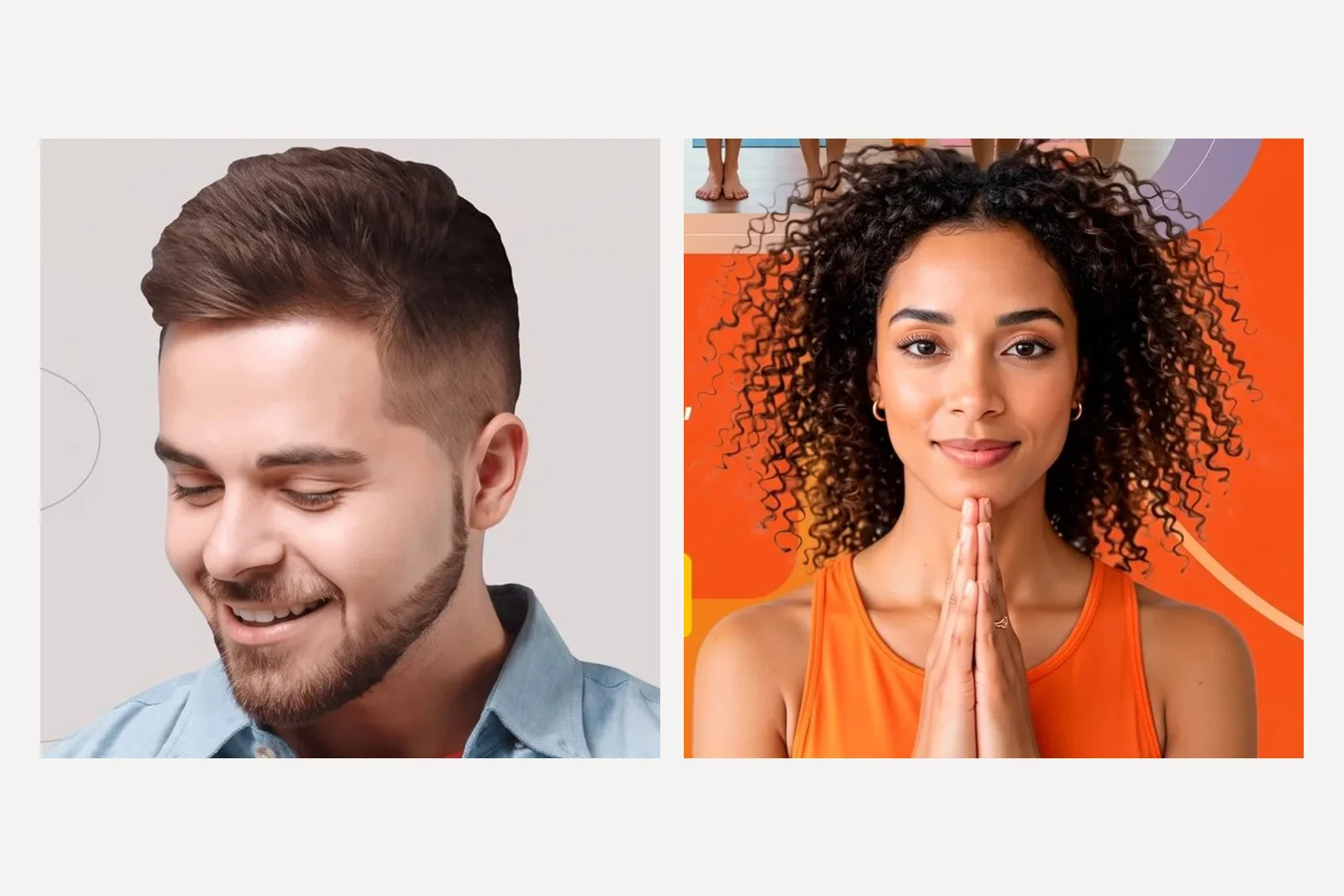
The man is smiling at a phone, head tilted down, eyes nearly shut. The woman is facing the camera but is cut out on an orange poster with parts of another photo behind her. Both are the kind of picture people actually own. Every prompt below that asks the model to keep the face uses the same sentence, so any difference between results comes from the model and not from the wording:
Keep this person's face exactly as it is in the attached photo: the same face shape, eyes, nose, mouth, skin tone, skin texture, hairline, hair and facial hair. Do not beautify, slim, smooth the skin or change their age. Change only what the rest of this prompt asks for.
What does a one-line headshot prompt give you?
Turn this into a professional headshot.
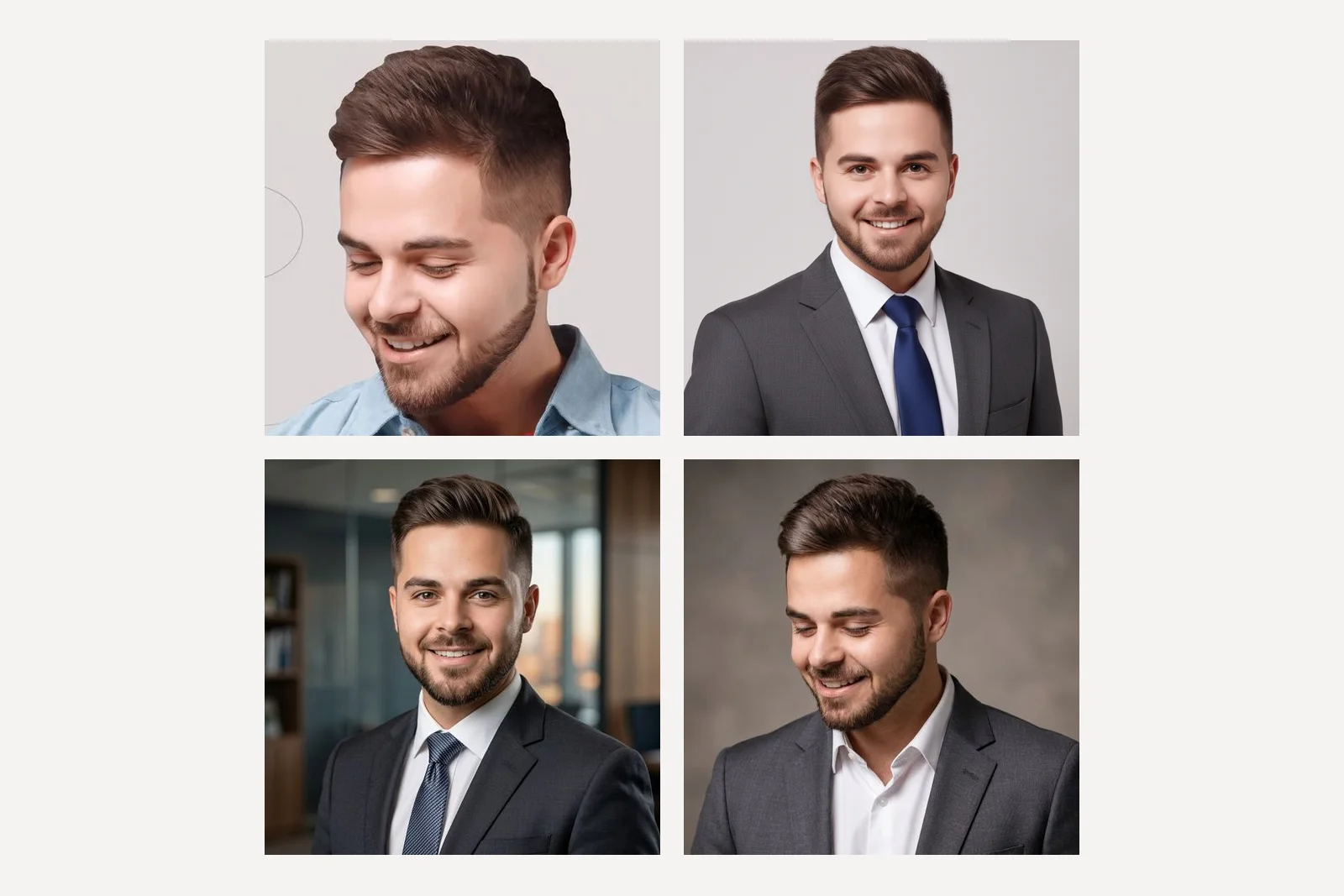
Professional, to an image model, means a dark suit and a tie. Nano Banana and Nano Banana 2 both added a tie, and Nano Banana 2 put him in a glass office with a city behind him. Both turned his head to the camera and opened his eyes. Nano Banana Pro did something more interesting: it changed his clothes but kept his head down and his eyes closed, exactly as in the original. It is the most faithful result and the least usable headshot.
The lesson is the same one we found with product photos: a short prompt is not neutral. The model fills every gap with its idea of the typical case, and the typical professional headshot is a man in a tie.
The LinkedIn headshot prompt
[Keep sentence] Make a LinkedIn profile photo: head and shoulders, facing the camera with the shoulders turned slightly, looking into the lens with a relaxed, natural smile. A dark navy blazer over a plain white crew-neck t-shirt. A plain, soft grey studio backdrop. Soft key light from the left with a gentle fill, no harsh shadows. Shot at eye level on an 85mm lens. Square crop, eyes about a third of the way down from the top.
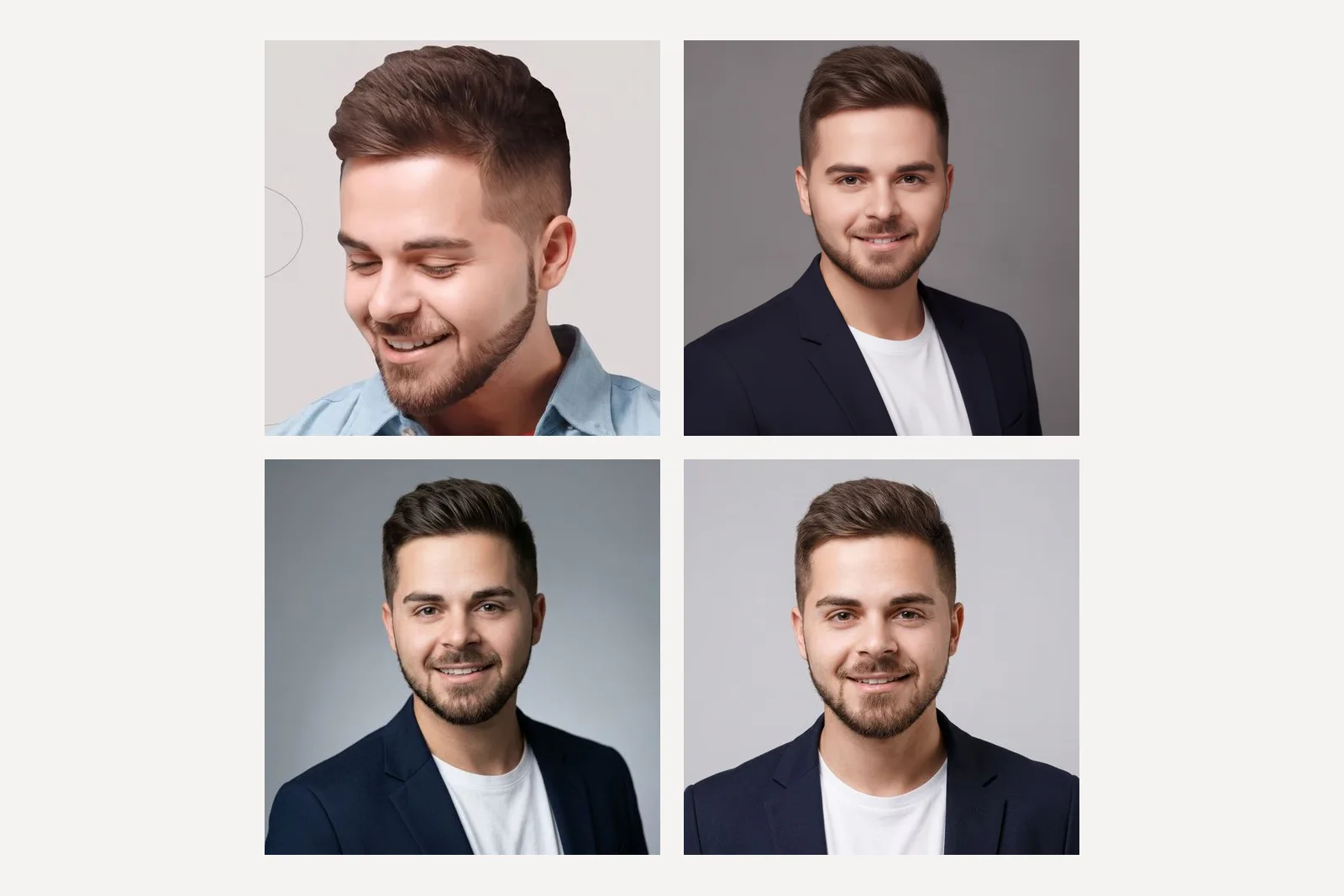
Every model followed the brief to the letter: blazer, t-shirt, grey backdrop, square crop, a smile into the lens. What differs is the face. Nano Banana made him look younger and softer around the jaw. Nano Banana 2 darkened his hair and broadened his face, and to us it reads as a brother rather than the same man. Nano Banana Pro kept the hairline, the fade, the beard line and the shape of the smile closest.
But look at the eyes in all three. The original shows almost none of them, so every pair here is invented. They are plausible, and they might be close. Nobody can tell from this photo, including the model. If your only good picture of yourself has you looking away, a headshot made from it is partly a guess, and you are the one person who can check whether the guess is right.
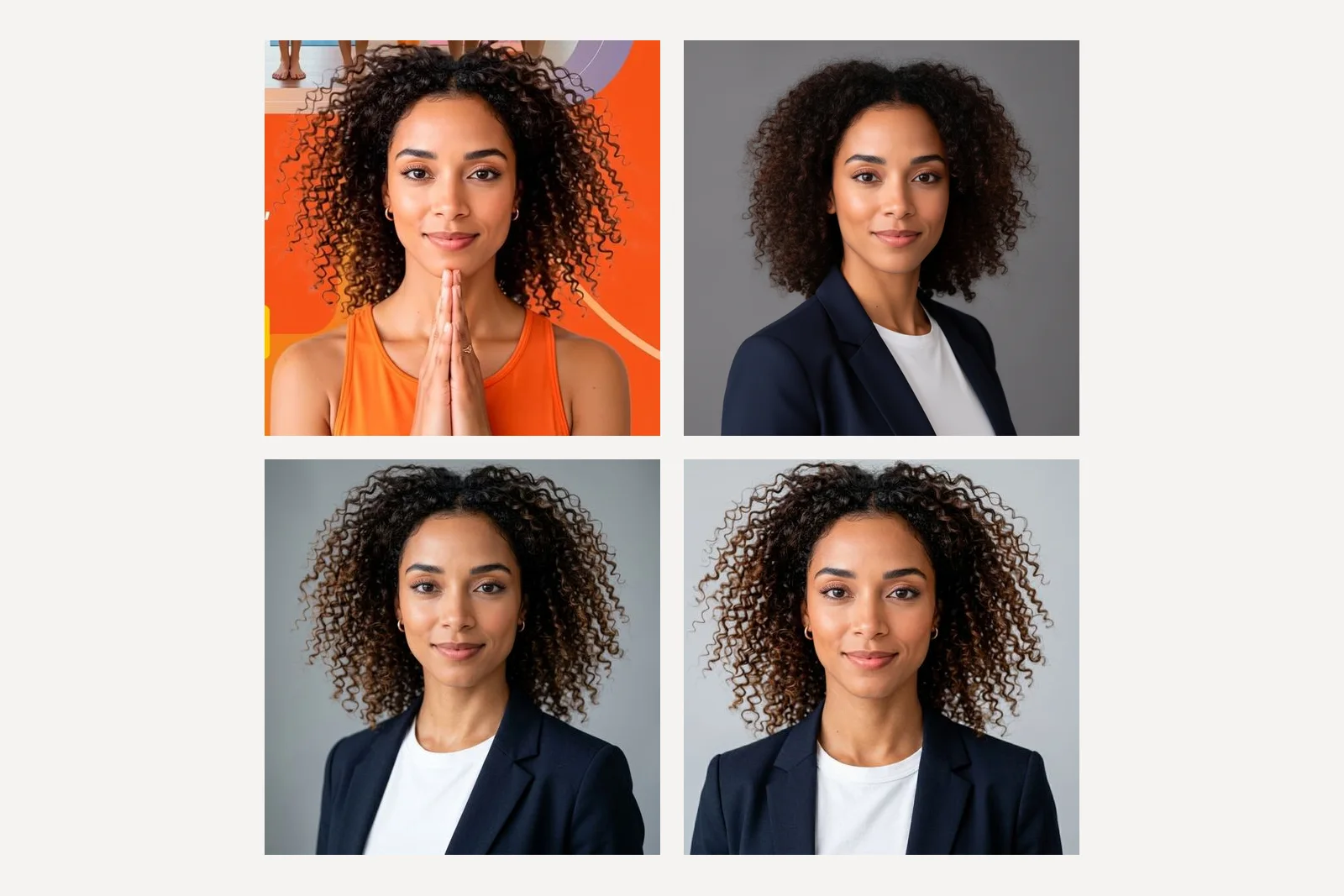
With the eyes visible in the original, the results were much closer. Nano Banana still took liberties: her long curls with lighter ends came back shorter, tighter and uniformly dark, and her gold hoops disappeared. Nano Banana 2 and Nano Banana Pro kept the hair, the colour at the ends and the earrings. Pro was the closest of the three again.
Did the keep sentence do anything?
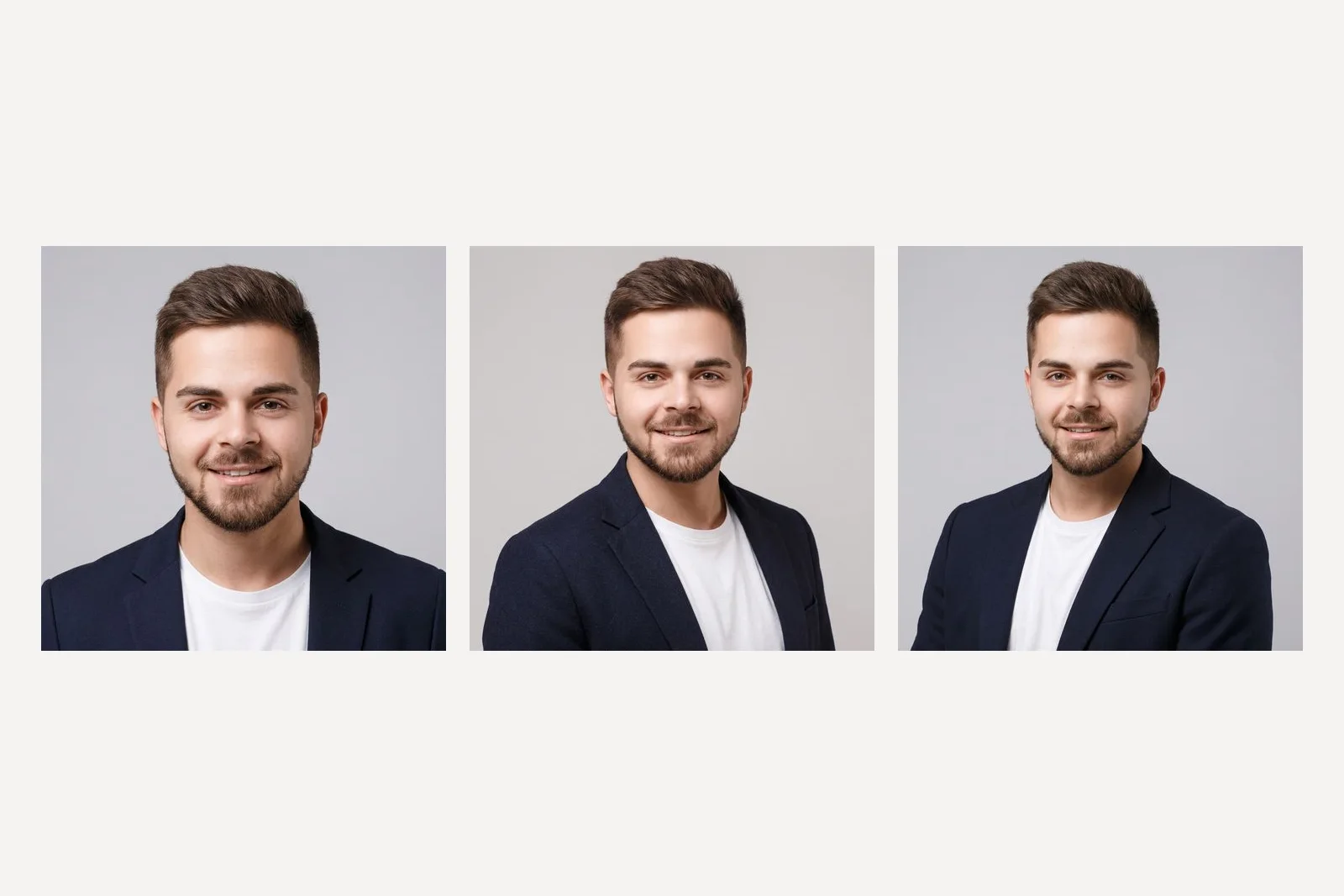
We ran the LinkedIn prompt on Nano Banana Pro twice more: once unchanged, and once with the keep sentence removed. All three came back close to one another. So on this model, in this test, the sentence made no visible difference, and we would rather say so than pretend it is a magic phrase. We still leave it in every prompt below, because it costs nothing and on older models the drift is larger, but the choice of model mattered more than the wording.
Why you need the photo, not a description
A professional LinkedIn headshot of a man in his late twenties with short brown hair, faded at the sides, and a short beard, wearing a dark navy blazer over a white t-shirt, in front of a plain grey studio backdrop, soft light, smiling.
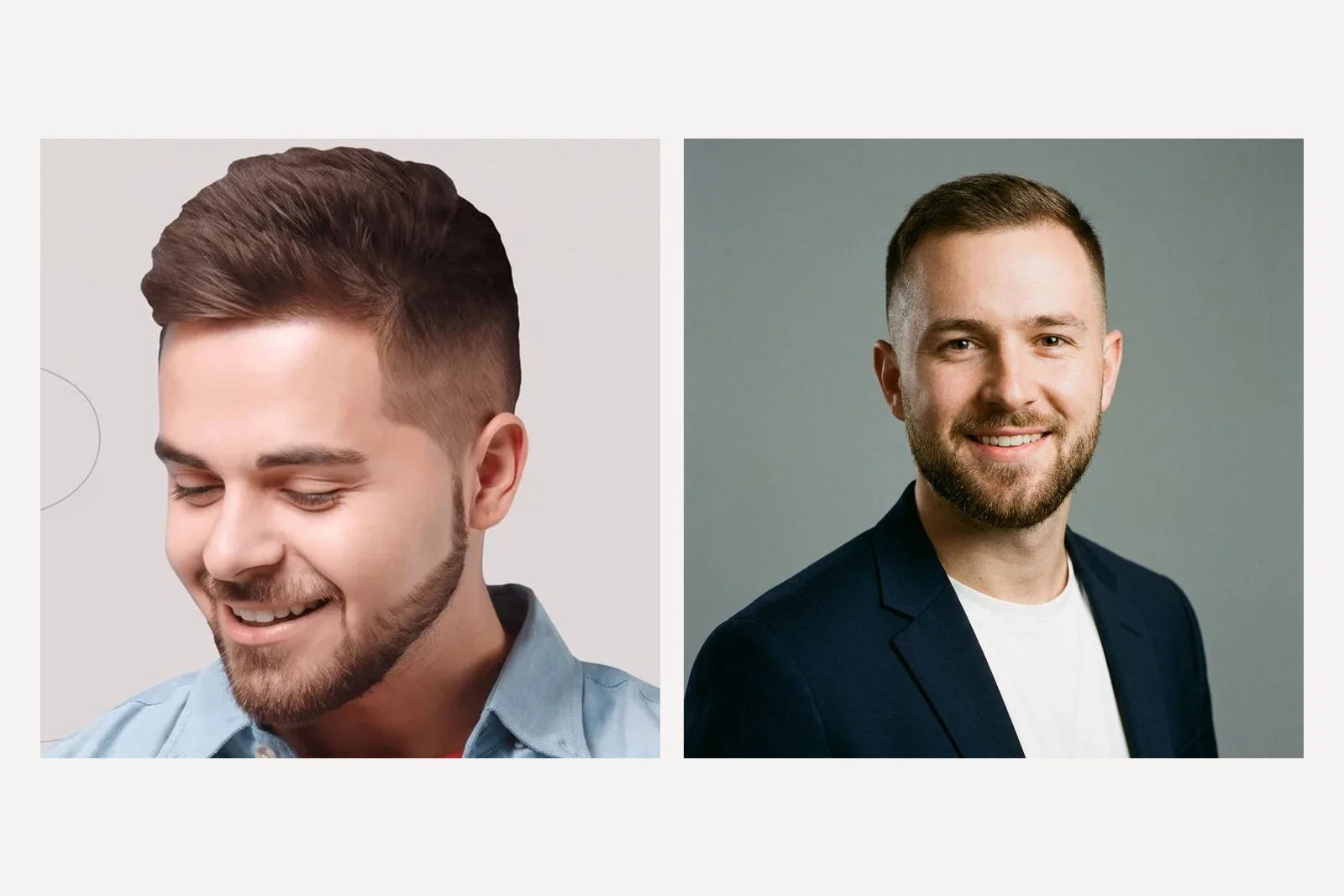
Every word of that description is true of the man on the left, and the result is a different person with a different hairline. It is obvious once said, and it is why every prompt on this page starts from an attached photo. A headshot that is not your likeness is also the one thing LinkedIn's rules rule out, which we come to below.
A photo for your About us or team page
[Keep sentence] A photo for a small business's About us page: from the waist up, standing in a bright, simple studio with a large window and a plant softly blurred behind her, arms relaxed at her sides, a warm closed-mouth smile. Keep her own clothes and earrings. Soft daylight from the window side. Shot at eye level on a 50mm lens. No text, no logo.
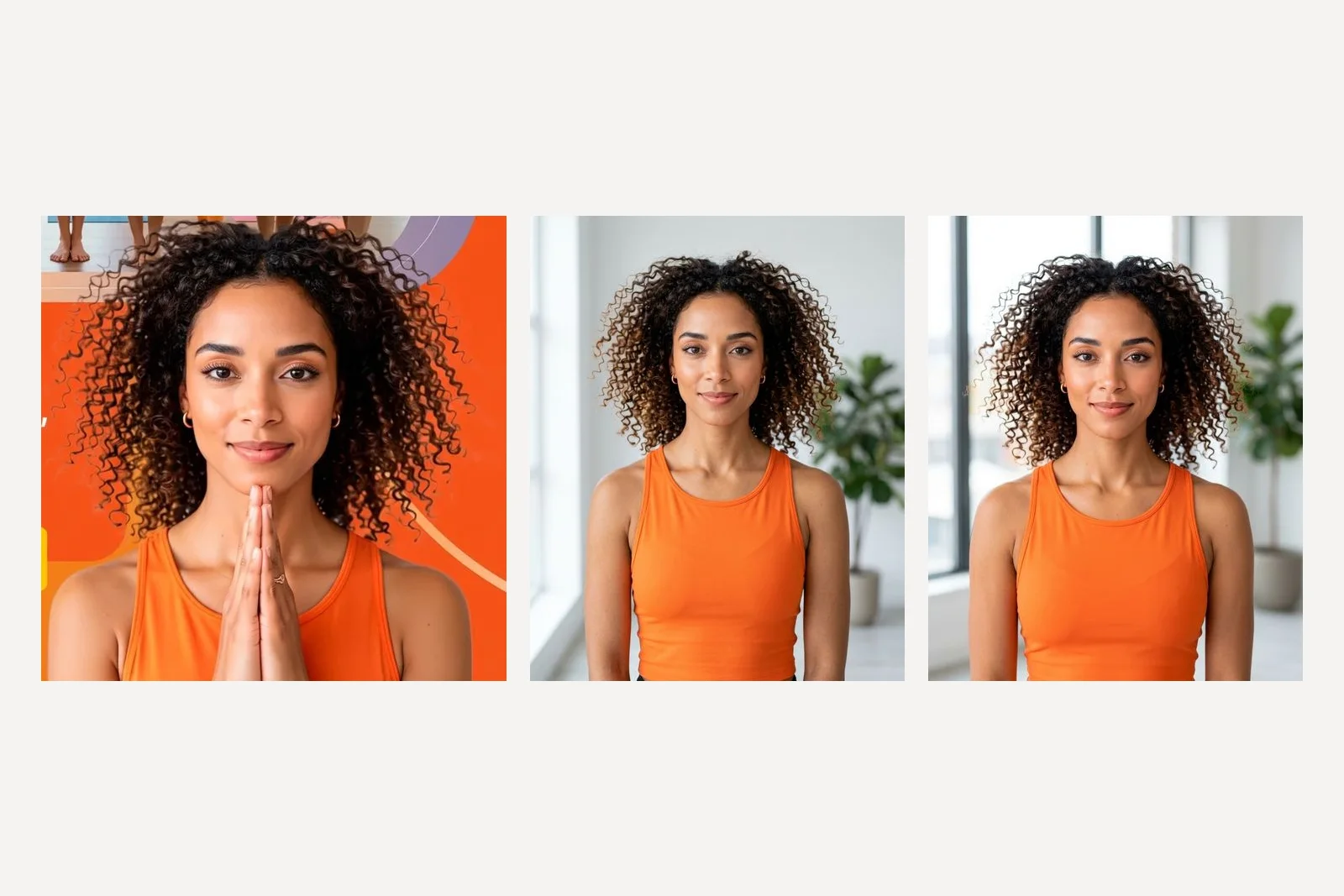
This is the prompt we would use for a small team, because it keeps the one thing that makes a team page believable: people in their own clothes. Both models kept the orange top and the earrings and moved her arms down as asked, which meant inventing her lower arms, not her face. Pro kept the face a little closer. For a team, run the same prompt for everybody and change only the pronoun, so the room and the light match across the page.
An outdoor, natural light portrait
[Keep sentence] A natural light portrait outdoors on a quiet city street in the late afternoon, soft warm light from behind her, the street softly blurred. Head and shoulders, looking into the lens, a relaxed smile. A plain cream knit jumper. No text.
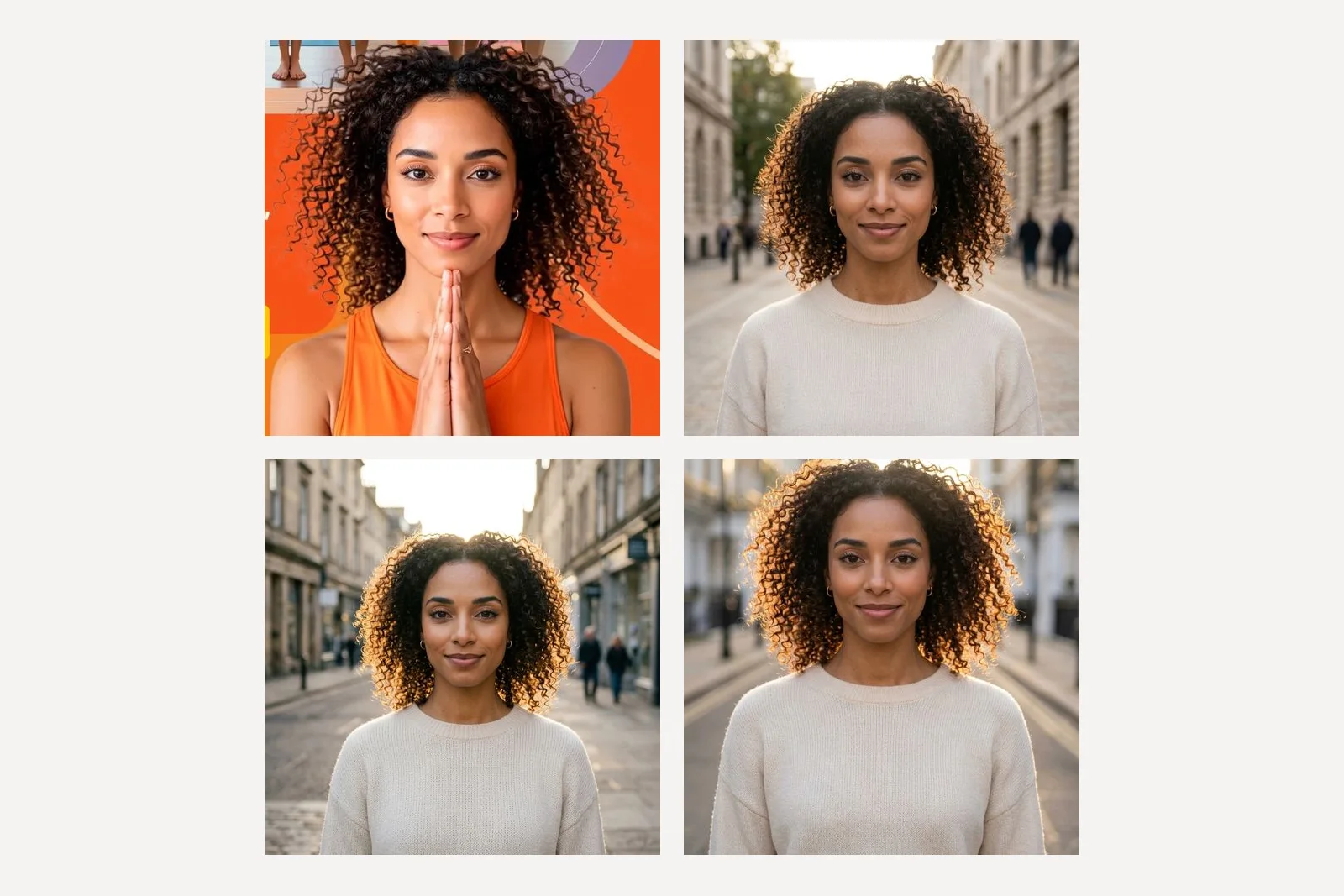
This is the failure worth seeing. Nano Banana 2 made a lovely portrait of a woman who is not quite her: a rounder face, shorter and fuller curls, different cheekbones. Since one run proves nothing, we sent the identical prompt again, and it did the same thing a second time. Nano Banana Pro, on the same prompt, stayed much closer. A bigger change of scene, light and clothes seems to give the faster model more room to drift, and that is exactly the kind of headshot people want most.
Google's own documentation has advice for this, under the heading High-fidelity detail preservation, and it names faces specifically:
To ensure critical details (like a face or logo) are preserved during an edit, describe them in great detail along with your edit request.
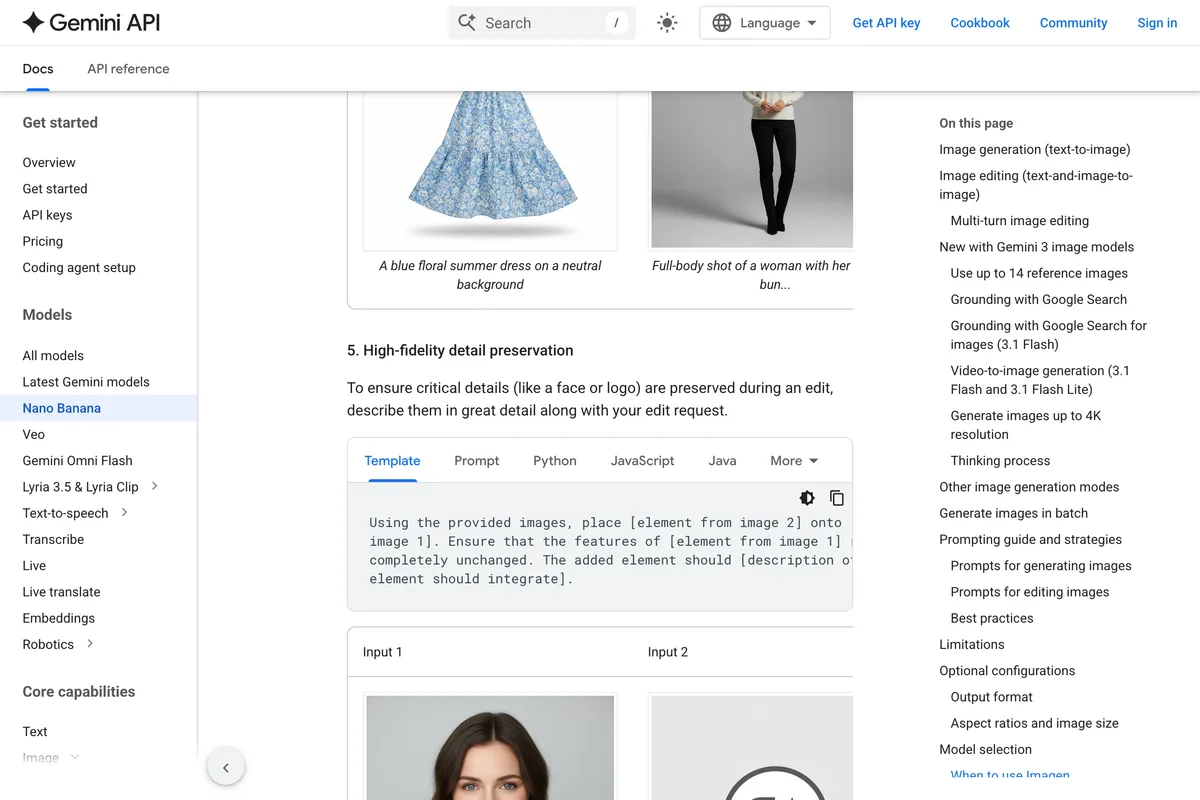
[Keep sentence] Her face: an oval face with high cheekbones and a narrow, softly pointed chin; light brown skin with a warm undertone and light freckling across the nose; dark brown almond-shaped eyes under full, arched, dark eyebrows; a straight, slim nose; medium full lips with a closed, slight smile. Long, dense, tight dark brown curls with lighter caramel ends, parted in the middle. Small gold hoop earrings. [Then the same outdoor scene.]
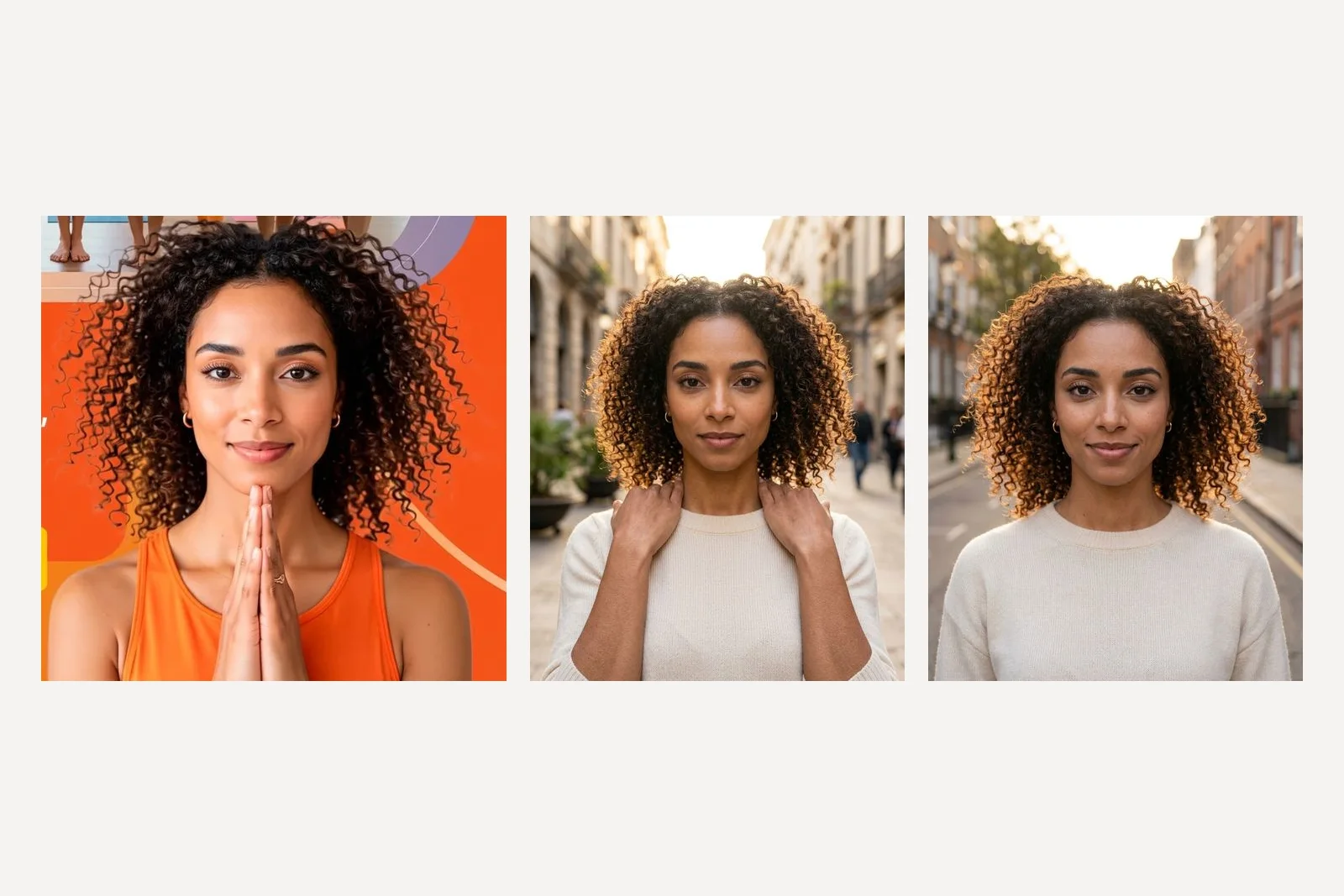
It helped. With the description, Nano Banana 2 got the cheekbones, the chin and the caramel ends of her hair back, and the face is recognisably hers. It also raised both her hands to the neckline of the jumper, a pose nobody asked for, which is a fair reminder that every extra sentence is something else for the model to act on. Nano Banana Pro was close with or without the description. If you are using the faster model, describe your own face in the prompt as plainly as you would to a sketch artist. If you are using Pro, it is optional.
The safest prompt: change only the background
Keep this photograph exactly as it is, including the person, her expression, her hands, her clothes, the crop and the light on her. Replace only the background with a smooth, even light grey studio backdrop, and remove everything else behind her.
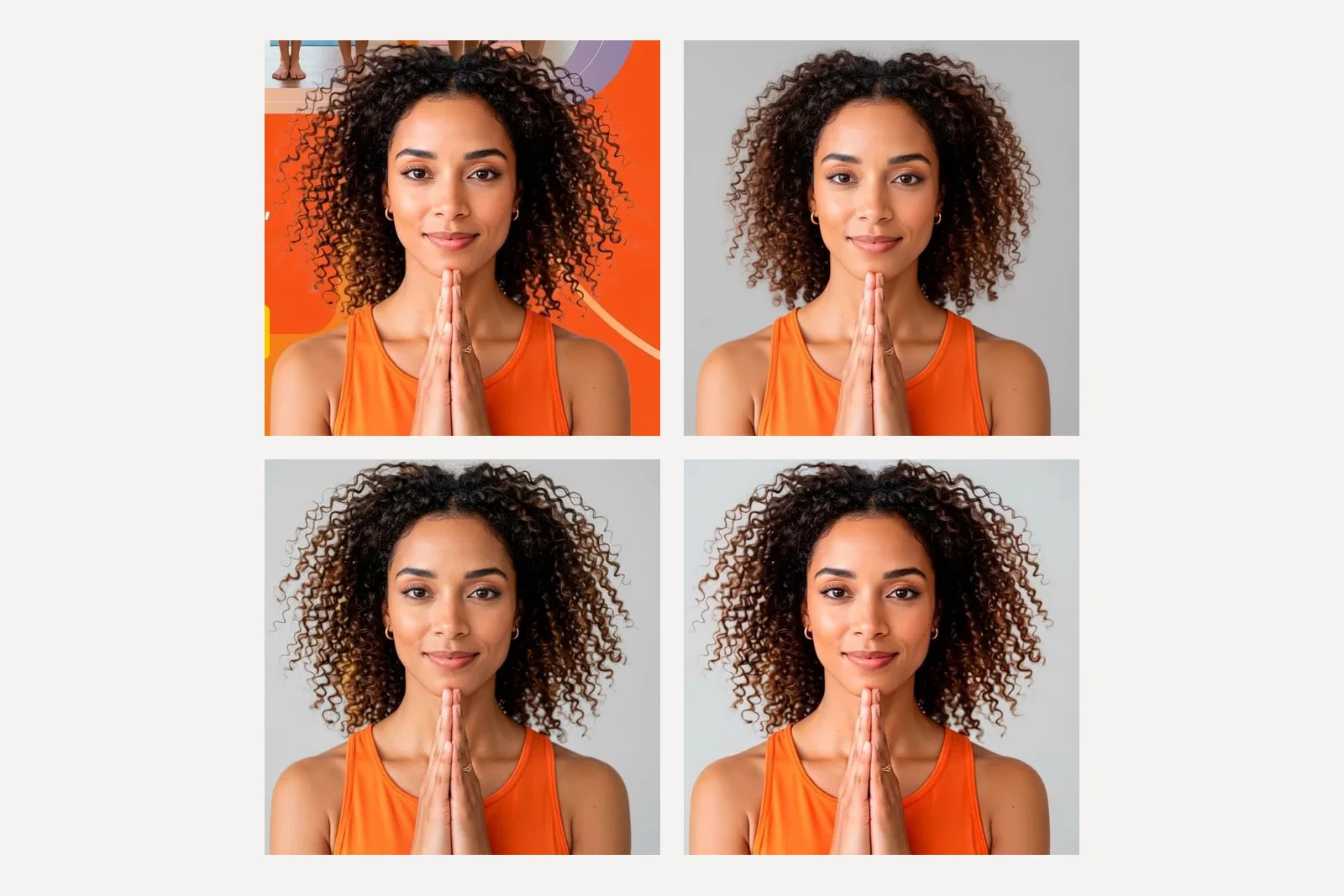
This is the best result on the page, and the least ambitious prompt. Nano Banana 2 and Nano Banana Pro removed the poster, the other photo and the orange, and kept her face, expression, hands, ring, top and hair. Nano Banana did the job but thinned her curls noticeably, which is the sort of change you only see side by side. If you already have a photo you like and it is spoiled by what is behind you, stop here. A new background changes the least about you and so has the least to get wrong.
Is an AI headshot allowed on LinkedIn?
LinkedIn does not ban AI edited photos. What it bans is a photo that is not you. The rule sits under fake profiles in its Professional Community Policies:
Do not use an image of someone else, or any other image that is not your likeness, for your profile photo.
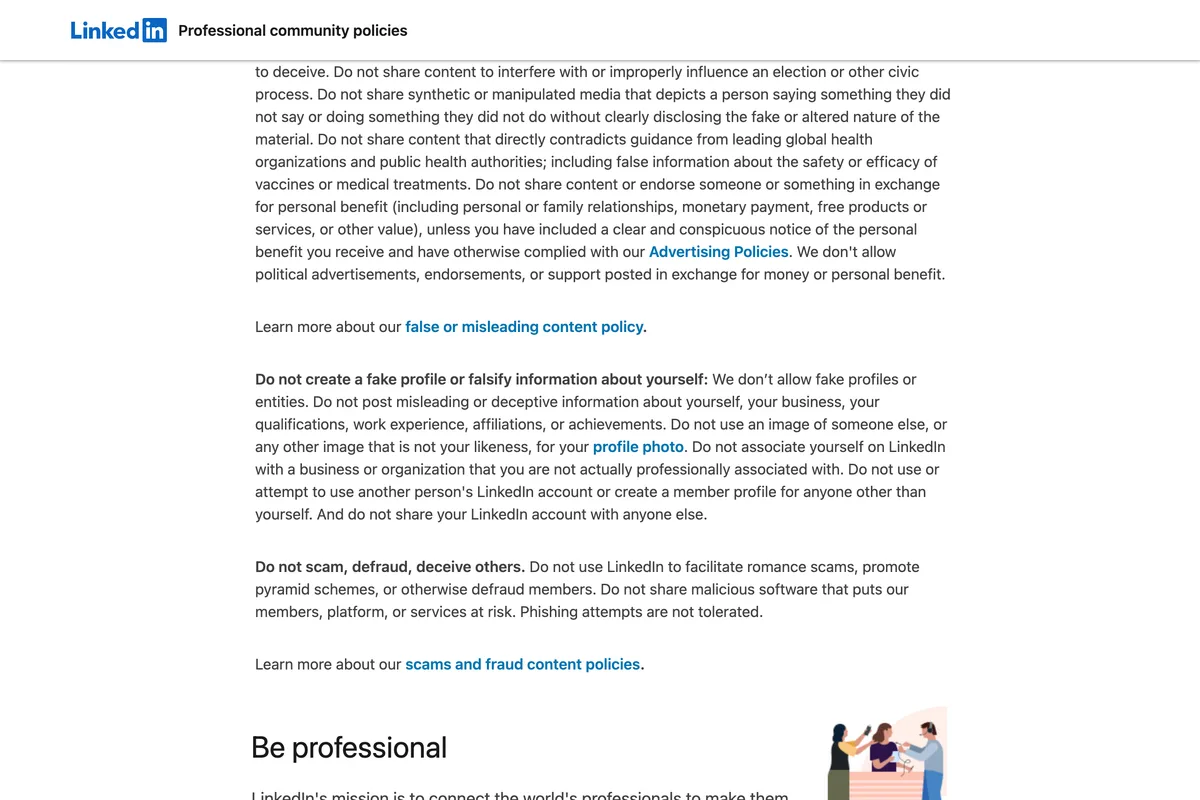
Read against our tests, that draws a practical line. A background swap of a real photo is plainly your likeness. A Pro headshot where your own face survived is too. The Nano Banana 2 outdoor portrait above, pretty as it is, is arguably not, and the description-only headshot certainly is not. The test is simple and nobody can apply it but you: would someone who met you last week recognise you from it? If you hesitate, use the photo that changed less. The rest of the profile is in our guides to LinkedIn headline examples and LinkedIn image sizes.
Will the photo be marked as AI?
All 22 files we got back carried a C2PA record, the same kind of signed note we found in every Gemini image we opened for why Instagram labels posts AI info. It says the image was made by Google's generative AI. We did not upload any of these anywhere, so we cannot tell you what LinkedIn or any other site does with that record. What we can tell you is that it is there when the file arrives, and that one ordinary re-save of the file removed it in our earlier test. Do not treat either fact as a reason to hide how the photo was made; treat them as a reason to know.
How to write your own headshot prompt
- Attach a real photo of yourself, the clearest you have with your eyes open and visible. If the model has to invent your eyes, it will.
- If the photo is good and only the background is wrong, use the background prompt above and nothing else.
- Name the clothes. Professional without clothes attached means a suit and tie.
- Say where the light comes from and what lens, because it decides whether the result looks like a photograph or a render.
- On Nano Banana or Nano Banana 2, describe your face in plain words as well, as Google's documentation advises. On Nano Banana Pro it made little difference in our test.
- Run it twice and compare with the original side by side, at the same size, before you use either.
Frequently asked questions
What is the best Gemini prompt for a professional headshot?
Attach a clear photo of yourself and name everything: the crop, the clothes, the backdrop, the light and the lens. Our LinkedIn prompt asked for head and shoulders, a navy blazer over a white t-shirt, a soft grey backdrop, key light from the left and an 85mm lens. A one-line prompt like turn this into a professional headshot put the man in a suit and tie in two of three models.
Which Nano Banana model keeps your face best?
Nano Banana Pro, in our test of 22 images. It kept both faces closest on every prompt. Nano Banana 2 kept the face well when only the background changed, but drew a noticeably different woman twice on an outdoor portrait. The original Nano Banana changed hair and removed earrings.
Can Gemini make a headshot without a photo?
It will make a headshot, but not of you. We gave Nano Banana Pro an accurate written description of our test subject with no photo, and it produced a different man with a different hairline. For a headshot of a real person the photo is not optional.
Are AI headshots allowed on LinkedIn?
LinkedIn's Professional Community Policies say not to use an image of someone else, or any other image that is not your likeness, for your profile photo. AI editing is not named. The practical test is whether the result still looks like you to someone who knows you.
How do I stop Gemini changing my face?
Use a photo where your face and eyes are clearly visible, change as little as possible, and describe your face in words in the prompt, which Google's Gemini documentation advises for preserving a face during an edit. In our test that description brought Nano Banana 2 much closer. Changing only the background kept the face almost perfectly on Nano Banana 2 and Pro.
Will an AI headshot be labelled as AI?
Every one of the 22 files Gemini returned in our test carried a C2PA record stating it was made by Google's generative AI. We did not upload them anywhere, so we cannot say what LinkedIn or other sites do with that record.
How we researched this
- Every prompt on this page was sent through Google's developer API on 29 September 2026 to three models: gemini-2.5-flash-image, gemini-3.1-flash-image and gemini-3-pro-image, which Google calls Nano Banana, Nano Banana 2 and Nano Banana Pro. Eight prompts produced 22 images. The picture that came back is the picture shown. Nothing was regenerated until it looked better and nothing was retouched.
- The two starting photos are crops of finished posts in our own gallery, not photographs of us. We picked them because neither is a headshot: the man is looking down at a phone with his eyes almost closed, and the woman is cut out on a busy orange layout with her hands pressed together. That is closer to what a business owner actually has than a studio portrait is.
- Judging whether a face stayed the same is judgement, not measurement. We compared each result with its reference side by side at the same size, and where we say a face changed, the band is printed so you can disagree. One run per prompt is a sample of one, which is why two prompts were run twice. The script that ran them is in our repository, so the test can be repeated when the models change.
- LinkedIn's rule was read on its own policy page on 29 September 2026 and is photographed in place. We did not upload any of these images to LinkedIn or anywhere else.
Sources