Why Instagram labelled your post AI info, and what is inside the file
Instagram does not look at your picture and guess. It reads a record the AI tool wrote into the file. We opened twelve images from Google's Gemini and found that record in every one, then watched it vanish on a single re-save.
You posted a picture and Instagram put a small label on it saying AI info. Maybe you did use an AI tool. Maybe you took the photograph yourself and only tidied it up. Either way, nobody at Meta looked at it, and no system studied the pixels and formed an opinion. In most cases Instagram read a note that was already inside the file, written there by the software that made or edited it.
Our articles are still written by humans!
Get human written articles in your Google feed.
We can show you that note. Our product generates posts with Google's Gemini, so on 20 September 2026 we took twelve images straight from Google's API and opened the files. Every one of them carried a signed record saying it was made by AI. Then we re-saved one, and the record was gone. Between those two facts is most of what is confusing about this label.
What the label is called this week
Part of the confusion is that the name keeps moving. Meta launched it as Made with AI. On 1 July 2024 it changed the wording to AI info, giving as its reason that content with only minor modifications using AI, such as retouching tools, had been carrying the indicators and was being labelled Made with AI. Instagram's help centre, read on 20 September 2026, calls it the AI content label. They are the same thing. This article says AI info because that is what most people type when they go looking for an explanation.
What you are and are not required to label
The rule is often repeated more broadly than Meta states it, so here is the wording itself, from Instagram's page on labelling AI content.
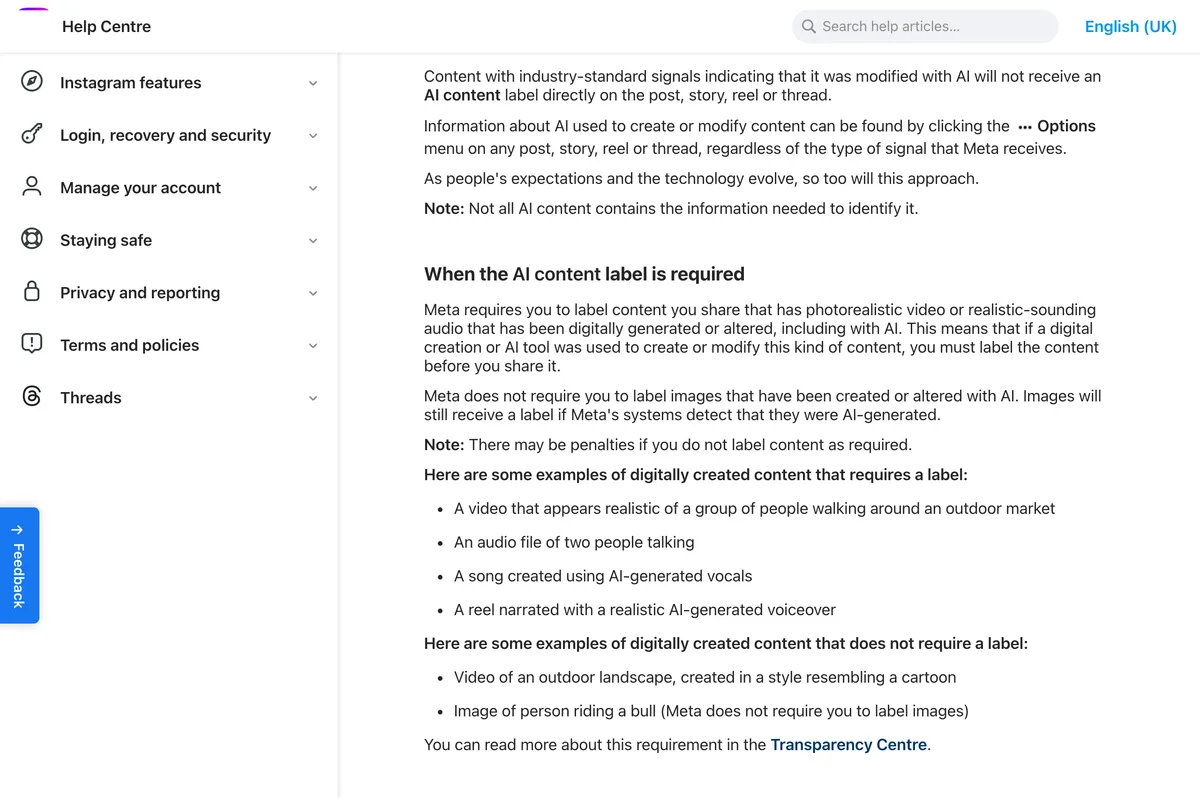
Meta requires you to label content that has photorealistic video or realistic sounding audio that has been digitally generated or altered, including with AI. Its examples are a realistic video of people walking around a market, and a Reel narrated by a realistic AI voice. It adds that there may be penalties if you do not label content as required.
Then the sentence that matters for almost every small business: Meta does not require you to label images that have been created or altered with AI. Images will still receive a label if Meta's systems detect they were AI generated. So for a designed post, a poster or a graphic, labelling is your choice, and the automatic label may arrive regardless.
| What you posted | Do you have to label it? | Can Instagram label it anyway? |
|---|---|---|
| An AI generated image or graphic | No | Yes, if its systems detect it was AI generated |
| A photograph edited with an AI tool | No | Not on the post itself. The information goes in the post's menu |
| Photorealistic AI video | Yes | Yes |
| Realistic AI voice or AI vocals | Yes | Yes |
| A cartoon style AI video | No, going by Meta's own example | Possibly, if it carries signals |
How Instagram knows
Instagram's page describes the mechanism plainly. Some content made or modified with AI tools may have an industry standard signal that identifies it, and these signals are read by Meta's systems to determine if the content needs a label. It gives a homely example: photo editing tools that use AI to change the size or colour of an image may add a signal showing that the content was modified using AI.
Meta named the standards when it announced the programme in February 2024: the AI generated information in the C2PA and IPTC technical standards. It said it would label images from Google, OpenAI, Microsoft, Adobe, Midjourney and Shutterstock as they implemented their plans for adding metadata. In the same post it admitted the limits. It is not yet possible to identify all AI generated content, it wrote, and there are ways that people can strip out invisible markers. Instagram's help page carries the same caveat in one line: not all AI content contains the information needed to identify it.
The other route is you. When you create a post there is a toggle to add an AI label, and Meta counts that self disclosure alongside the signals it detects. The scale is not small. Meta's transparency centre reported that between 1 and 29 October 2024 there were over 330 million labelled pieces of content on Instagram on which people had viewed the label.
What we found inside twelve Gemini images
Google's documentation for its image models states that all generated images include a SynthID watermark. SynthID is invisible and lives in the pixels, so there is nothing to see by opening a file. C2PA is different. It is a signed record stored in the file alongside the picture, and you can find it with nothing more than a script that walks the file's structure.
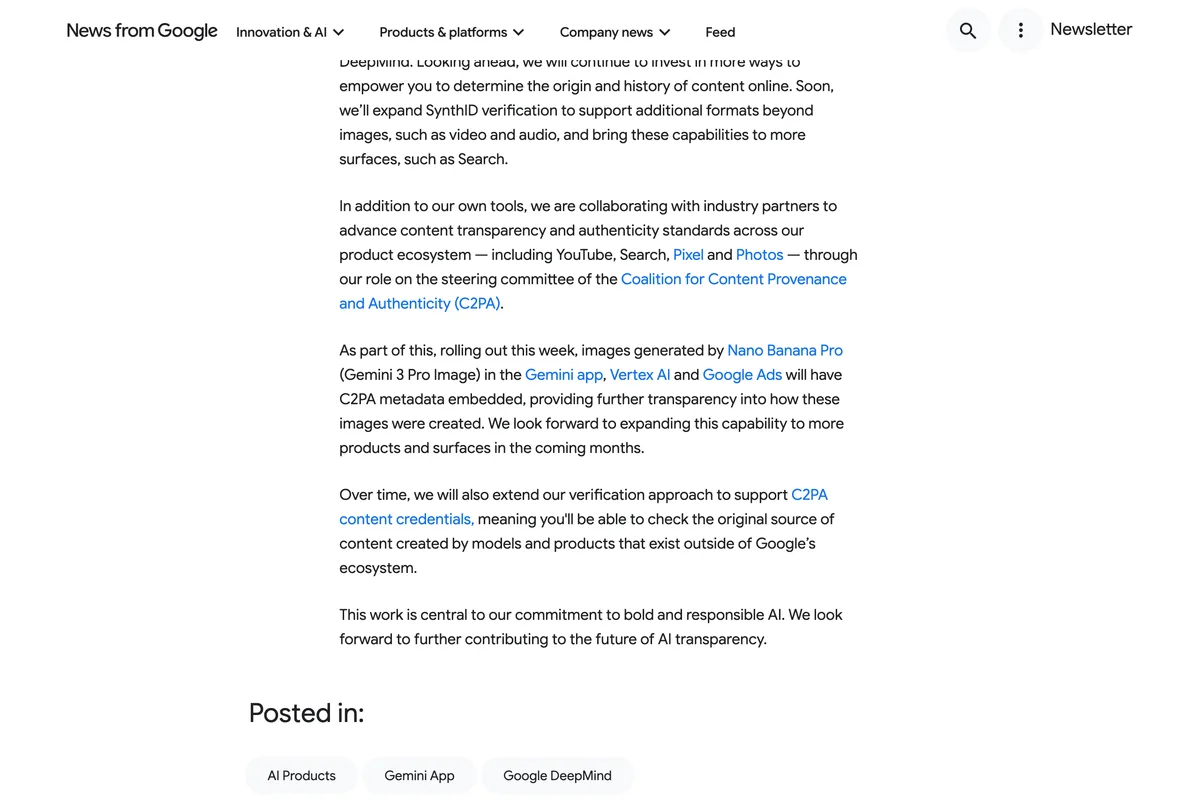
Google announced in November 2025 that images from its Gemini 3 Pro Image model in the Gemini app, Vertex AI and Google Ads would have C2PA metadata embedded. Our images came from none of those. They came from the developer API, the route a product like ours uses. So we did not know what we would find.
We had not expected that, and it corrected something we believed. Earlier the same day we had scanned all 417 images in our own gallery, found no AI markers in any of them, and nearly concluded that Gemini's API output is unmarked. It is marked. Our pipeline resizes every image before publishing, and the resize had been quietly discarding the record each time. That was a side effect of how we save files, not a decision anybody made.
Why the same picture is labelled for one person and not another
This is the practical consequence, and it explains most of the puzzled threads on the subject. The record rides along with the file and survives only as long as nothing rewrites the file without carrying it over. Download an image from an AI tool and post that exact file, and the record is there for Instagram to read. Take a screenshot of it, run it through an editor that exports a fresh copy, or send it through a messaging app that compresses pictures, and the chances are the record does not come with it.
It works in the other direction too. A photograph you took yourself can pick up a signal from an editing tool that uses AI for a small job, which is the case Instagram's own help page describes. Since 12 September 2024 Meta has handled that case more gently: for content it detects was only modified or edited by AI tools, the AI info label moved off the post and into the post's menu. If the label is sitting on the face of a real photograph of yours, the likeliest cause is that a tool in your workflow described its export as AI generated when it had only been AI edited.
We are not going to turn that into a guide to removing labels. Meta has said in public that markers can be stripped, so none of this is a secret, but the label exists so that people are not misled by pictures that look real. If your post is a designed graphic, a label on it misleads nobody and costs you nothing we can measure. If your post is an AI picture that could pass for a photograph of your premises, your food or your staff, the honest move is to label it yourself, or better, to not post it. We made that argument about generated workshops and generated products in our Gemini poster prompts, and it is the same argument here.
What we do not know
- Whether the label reduces reach. Meta has published nothing on it. We read its ranking documentation closely for how the Instagram algorithm works in 2026 and found no mention of the label as an input. Absence from a document is not proof of absence from a system.
- Whether Meta reads SynthID. Its announcements name C2PA and IPTC. SynthID is Google's own watermark and sits in the picture itself, not in the segment of the file our re-save discarded, so losing the record does not mean losing the watermark. We did not test whether it survived, and Meta has not said whether its systems check for it.
- Whether Instagram labels every file that carries a C2PA record. We showed the record is in the file. We did not upload the file and watch.
- Whether the label changes how customers see a business. There is plenty of opinion on this and we have not seen evidence worth repeating.
What to do about it
- If the post is a graphic or a poster, leave it. You are not required to label an image, and a label on an obvious design tells nobody anything they had not assumed.
- If the post is AI video that looks real, or uses an AI voice, label it yourself with the toggle when you create the post. That one is a requirement and Meta says penalties may apply.
- If the label is on a genuine photograph, look at the last tool that touched it. Generative fill, AI background removal and AI upscaling are the usual sources. Export the photograph without that step and compare.
- If customers ask, tell them. The businesses that get into trouble over AI are the ones that implied a picture was real. How that plays out in writing is in why AI posts sound like AI.
Frequently asked questions
Why is my Instagram post saying AI info?
Usually because the file you uploaded carried a signal saying AI was involved. Meta says its systems read industry standard signals that AI tools add to content, and it has named the C2PA and IPTC standards. The label can also appear because you switched on the AI label yourself when posting. It does not mean a person at Meta reviewed your picture.
Do I have to label AI images on Instagram?
No. Instagram's help centre states that Meta does not require you to label images that have been created or altered with AI. The requirement applies to photorealistic video and realistic sounding audio that was digitally generated or altered. Images can still receive a label automatically if Meta's systems detect they were AI generated.
Why does my real photo say AI info?
Most likely an editing tool added a signal. Instagram's own example is a photo editing tool that uses AI to change the size or colour of an image. Since 12 September 2024 Meta puts the label for content that was only edited with AI in the post's menu, not on the post, so a label on the face of a real photograph suggests a tool described its export as AI generated.
Do images made with Google Gemini get labelled on Instagram?
They carry what Meta says it looks for. All twelve images we took from Google's Gemini API on 20 September 2026 contained a signed C2PA record reading Created by Google Generative AI, with the IPTC source type for AI generated media. We did not upload them to confirm the label appears, and the record was lost when we re-saved the file.
Is AI info the same as Made with AI?
Yes. Meta launched the label as Made with AI and renamed it AI info on 1 July 2024, saying that content with only minor AI modifications, such as retouching, had been labelled Made with AI. Instagram's help centre in September 2026 calls it the AI content label. All three names refer to the same system.
Does the AI info label reduce reach?
Meta has not said. We found no mention of the label in Meta's published ranking documentation, but a document not mentioning something is not proof that the system ignores it. Anyone quoting a percentage has no public source for it.
What is the difference between C2PA and SynthID?
C2PA is a signed record stored in the file next to the picture, saying what made it. It is easy to read and easy to lose: one re-save removed it in our test. SynthID is Google's watermark, which Google says is included in all its generated images and which the record in our files describes as imperceptible. It sits in the picture itself, so it is not removed just because the record is. Meta's announcements name C2PA and IPTC, and do not mention SynthID.
How we researched this
- The test in this article is small and exact. On 20 September 2026 we generated twelve images with gemini-3-pro-image through Google's developer API and saved the bytes exactly as they arrived, with no re-encoding. We then read the structure of each JPEG file and searched it for the markers the C2PA and IPTC standards define. All twelve carried the same kind of record. We then re-saved one of them three ways with a common image library and looked again.
- What we did not do is the last step. We did not upload a marked file and an unmarked file to Instagram to see which one was labelled. We can show you what is in the file and what Meta says it reads. We cannot show you Meta's system reading it, and the article is careful not to claim that. If you run that test, we would like to hear the result.
- Meta's statements were read on its own pages on 20 September 2026 and the central one is photographed in place. Meta has renamed this label twice and moved it once, so expect the wording to change again. Nothing here is advice on how to avoid a label. It is an account of where the label comes from.
- We sell a product that generates posts with this model, so we have an interest in AI labels seeming harmless. Read the section on what we do not know with that in mind.
Sources