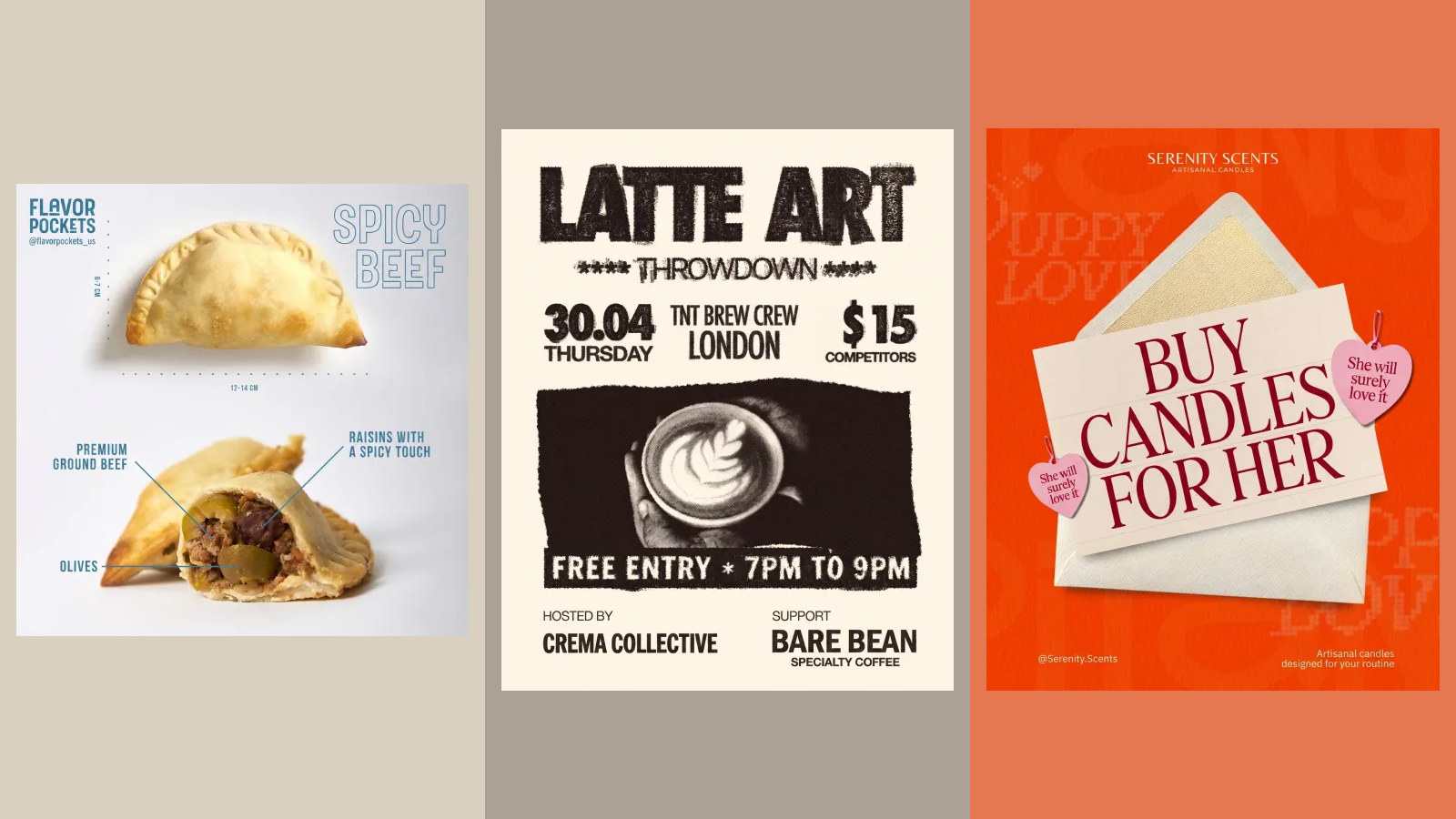
30 Instagram post ideas for a small business, with the posts already made
Thirty things a small business can post this month, sorted by where the material comes from, each with the headline pattern that makes it work and eight of them shown as finished posts. Plus the five ideas every list includes that you should skip.

Most lists of Instagram post ideas are written for brands with a content team, and they read like it: run a giveaway, start a series, film a day in the life. This one is for the person who owns the shop and has eleven minutes between customers. Thirty ideas, sorted by where the material comes from, each with the headline pattern that makes it work, and eight of them shown as finished posts so you can see the shape rather than imagine it. If you want the strategy underneath, the six kinds of post a small business has is the shorter, more abstract version of this article. This is the long, concrete one. If you want the sizes to export them at, that is a separate page.
Our articles are still written by humans!
Get human written articles in your Google feed.
The offer: five posts about what you are actually selling this week
The most useful post a small business can make is also the one it makes least, because it feels too obvious. Say what you are selling. Not the brand. The thing, this week, at this price, and how to get it.
- What just came in. Headline pattern: "[Thing] is in" or "[Thing] are back". The seasonal arrival is the oldest post there is and it still works because it is news.
- The price, plainly. Pattern: "[Thing], [price]". A photograph of the thing and the number, nothing else. Half the messages a small business gets are asking this.
- The one thing you are known for. Pattern: "The [thing]". If everybody who comes in asks for the same thing, that is your post, once a month, forever.
- A slot that is free this week. Pattern: "[Day] at [time] is free". Turns an empty appointment into a post in thirty seconds. Works for anyone who books time.
- The bundle. Pattern: "[Thing] and [thing], together". Two things people buy separately, offered as one, with the reason they go together.


The work: five posts from what you did today
The work is the material most businesses have most of and use least. Every job you finish is a post, and the ones that get comments are the ones that show a thing being done rather than a thing being sold.
- Before and after, with permission. Pattern: "[What it was] to [what it is]". Ask the customer first, in writing if the picture shows their face, their home or their body. Dentists have a whole rulebook for this and everyone else has manners.
- The mistake you fix most often. Pattern: "Why the [thing] [does that]". The tap drips, the fur mats, the hem goes. You know why, the customer does not, and telling them is the most generous post you can make.
- The process in one frame. Pattern: "How we [do the thing]". One photograph mid job. Not a tutorial, a glimpse. The comment you want is "I had no idea that was how it worked".
- The tool you use every day. Pattern: "This does [the thing]". The needle, the wrench, the knife, the brush. People like the objects of a trade more than the trade admits.
- What a job costs, and why. Pattern: "What [job] costs". The single most searched question about any service, answered in a post, with the reason attached. It filters out the wrong customers before they call.


The people: five posts about who is behind the counter
A chain cannot make these posts and you can, which is the whole argument for making them. They are also the ones owners resist most, because they feel like showing off. They are not. They are answering the question every new customer has: who am I about to deal with.
- The person who answers the phone. Pattern: "Ask [name]" or "Meet [name]". One person, named, who a customer will actually speak to. Not a team photograph.
- The newest member. Pattern: "[Name] started [when]". A first week is news to nobody but your customers, and it is exactly the size of news a feed is for.
- The owner's why, in one sentence. Pattern: "Why we [do this]". Not the mission statement. The sentence you say when somebody at a party asks what you do and looks interested.
- A customer, with permission. Pattern: "[Name] came in for [thing]". The endorsement rules apply if you gave them anything for it, so give them nothing and just ask nicely.
- A supplier. Pattern: "[Thing] comes from [where]". The farm, the mill, the wholesaler. It answers where the thing comes from, which is a question more people have than ask.

The place: five posts about where you are
You are a local business, so being findable locally is most of the job, and the place is material you have for free. These posts are boring to make and they are the ones that turn a search into a visit.
- The door, and how to find it. Pattern: "[Colour or landmark] door on [street]". The photograph a first time visitor needs and no business posts.
- The quiet hour. Pattern: "Quiet at [time]" or "Quiet after [time]". Some customers want the busy hour and some want the empty one, and only you know when each is.
- What is on the counter today. Pattern: "On the counter today". Same angle, different day. A series that costs nothing and tells a regular whether to come in.
- The view from the counter. Pattern: "From here". Your side of the room. Nobody else has this photograph and it makes a place feel like a place.
- The street outside. Pattern: "[Street] this morning". Weather, market day, roadworks. It says you are there, today, which is the thing a feed is supposed to say.

The answers: five posts from the questions you get asked
Every question a customer asks you twice is a post, and it is a post that will be found by the next person about to ask it. This is where a small business feed does the work of a website that never got written.
- The question you were asked three times this week. Pattern: the question, as asked, as the headline. "Do you do [thing]?" Then the answer in one line.
- What to bring. Pattern: "What to bring". For a first visit, a fitting, an appointment. Four things at most. It removes the reason people put off coming in.
- The myth. Pattern: "[Thing people believe] is not true". Every trade has one. Correcting it kindly is a post people save.
- When to call and when not to. Pattern: "Call us if [this]. Not if [that]." It sounds like turning work away. It is the most trusted post a service business can make.
- The checklist. Pattern: "[Number] things before [event]". Before winter, before a holiday, before you sell the house. Short, and only things you would actually say.

The calendar: five posts the year hands you
The calendar is the one source that will never run dry, and it is also where most of the filler comes from, so the rule here is stricter than elsewhere: post the dates that change what a customer should do, and skip the ones that only mark time.
- The season, as it affects the thing you sell. Pattern: "[Season] [thing]". Winter tyres, summer hours, autumn planting. Not "happy autumn".
- The deadline. Pattern: "[Thing] by [date]". Order by, book by, file by. Accountants live on these and every trade has one.
- Closed, and back when. Pattern: "Closed [day], back [day]". The most useful post of any holiday weekend, and most businesses post a greeting instead.
- A first. Pattern: "First [thing] of the year". First strawberries, first frost, first wedding of the season. Small, true, and only postable once.
- An anniversary that is true. Pattern: "[Number] years". Post it if it is a real number and once. Not "since 1987" if you opened in 2019, which is exactly the figure an AI will invent for you if you let it.

How to turn any of these into a post in two minutes
- One photograph, taken by you, of the actual thing. Not stock. A slightly worse photograph of your real counter beats a perfect one of somebody else's.
- One headline, in the pattern above, that a customer could have typed into a search box. Two to four words. If it sounds like a slogan, it is the wrong headline.
- One line under it that says the detail: when, how much, where, who. The line is where the information lives; the headline is only what stops the scroll.
- One thing to do next, if there is one. Book, order, come in, ask. Not three.
- Up to five hashtags if you must, which is now the limit anyway, and probably none. The words in the post do more than the tags under it.
That is the entire template, and it is the one every finished post in this article follows: one picture, one headline, one line, one action. It is also, not by coincidence, the shape that keeps a post from sounding like it was written by a machine, because it leaves no room for the padding that machines and tired people both reach for.
The five ideas every list includes that you should skip
These are on every other list of Instagram post ideas, and we have generated every one of them ourselves and watched them do nothing. They are here so you can recognise them and stop.
- The giveaway. It buys followers who wanted the prize, not the business, and it costs you the prize. The one exception is a giveaway of the thing you sell, to people already following, once a year.
- The quote card. An inspirational sentence over a gradient. It could be posted by anyone, which means it says nothing about you, and the feed is full of them.
- The holiday greeting. Happy Easter, happy new year, happy Friday. It marks time and does nothing else. Post the hours instead.
- The hashtag wall. Thirty tags under a two word caption. The platform has capped it at five, and it looked like desperation before the cap.
- Anything you would not say out loud to a customer at the counter. Elevate your journey. Unlock your potential. Your one stop shop. If it would be strange spoken, it is strange posted.
How often to post from this list
Fewer than you think. Two or three a week from different groups above, so a fortnight has an offer, a piece of work, a person, a place, an answer and a date in it, beats a daily post from one group. Thirty ideas is not a month of daily posts. It is three months of good ones, and then you start again at the top, because plums come in every year.
If drafting the thirty is the part that stops you, that is what our product does from your website and reviews, and what a chat model will do if you give it this list and your last ten reviews. Either way, the photograph is still yours to take, and the two minutes of judgement before it goes out are still yours to spend.
Frequently asked questions
What should a small business post on Instagram when it runs out of ideas?
Go back to the six sources: what you are selling this week, a job you finished today, a person behind the counter, the place itself, a question a customer asked, and the next date on the calendar that changes what a customer should do. One of them always has something in it.
What makes a good Instagram post for a small business?
One photograph of the real thing, one headline a customer could have typed into a search box, one line with the detail, and one thing to do next. Every strong post in this article follows that shape.
How often should a small business post on Instagram?
Two or three times a week, from different sources, is plenty. Thirty ideas is three months of good posts, not one month of daily ones.
Should a small business do Instagram giveaways?
Rarely. A giveaway buys followers who wanted the prize, not the business. If you do one, give away the thing you actually sell, to people already following you, and not more than once a year.
Do I still need hashtags on Instagram posts?
Instagram now limits posts to five, and the words in the headline and caption do more for being found than the tags under them. Use up to five if you like, and none if you cannot think of five that a customer would search.
How we researched this
- The thirty ideas are sorted by where the material for the post comes from, because that is what actually decides whether a business can make it this week: an idea that needs a photographer is not an idea, it is a project. Every one of these can be made with a phone, by the owner, in the time it takes the kettle to boil.
- The eight posts shown were made by our own product for businesses we invented, from briefs we wrote by hand so that each one demonstrates the pattern it sits under. They are the shape of the idea, not proof that the idea works for you, and the businesses do not exist. We looked at what designers publish on Behance for small business feeds before writing the briefs, and took from it the one thing that recurs in the good ones: the photograph does the work and the words stay out of its way.
- The five ideas we tell you to skip are ideas we have generated ourselves and watched fail. It is easier to list what to post than what not to, and the second list is the one that saves you the most time.
- Instagram's hashtag limit is read from Social Media Today's report of the change, opened on 17 August 2026 and linked below. We sell a tool that drafts posts like these; that is disclosed where it becomes relevant.
Sources