Why TikTok labelled your post AI-generated, and what is inside the file it read
TikTok does not have to guess. When an image or video arrives carrying a signed record from the AI tool that made it, TikTok reads the record and applies the label, and the label cannot then be removed. We opened the files Gemini returns, found that record in all 22, and watched it vanish on a single re-save.
You posted a picture or a video and TikTok put a small label on it: AI-generated. Maybe you did use an AI tool for the image. Maybe you only used one for the background, or for a product shot you then put in a video. Either way, in most cases nobody at TikTok looked at it. TikTok read something that was already inside the file.
Our articles are still written by humans!
Get human written articles in your Google feed.
We can show you that something. We generated 22 images with Google's Gemini on 29 September 2026, opened the files, and found a signed record in every one saying where it came from. Then we re-saved one on a Mac, and the record was gone. That pair of facts explains most of what is confusing about this label, including why the same picture can be labelled for one account and not another.
| Label | Who applies it | Can you remove it? | What TikTok says about reach |
|---|---|---|---|
| AI-generated | TikTok, from its AI effects, Content Credentials in the file, or its own detection | No, TikTok says it cannot be removed | Nothing specific |
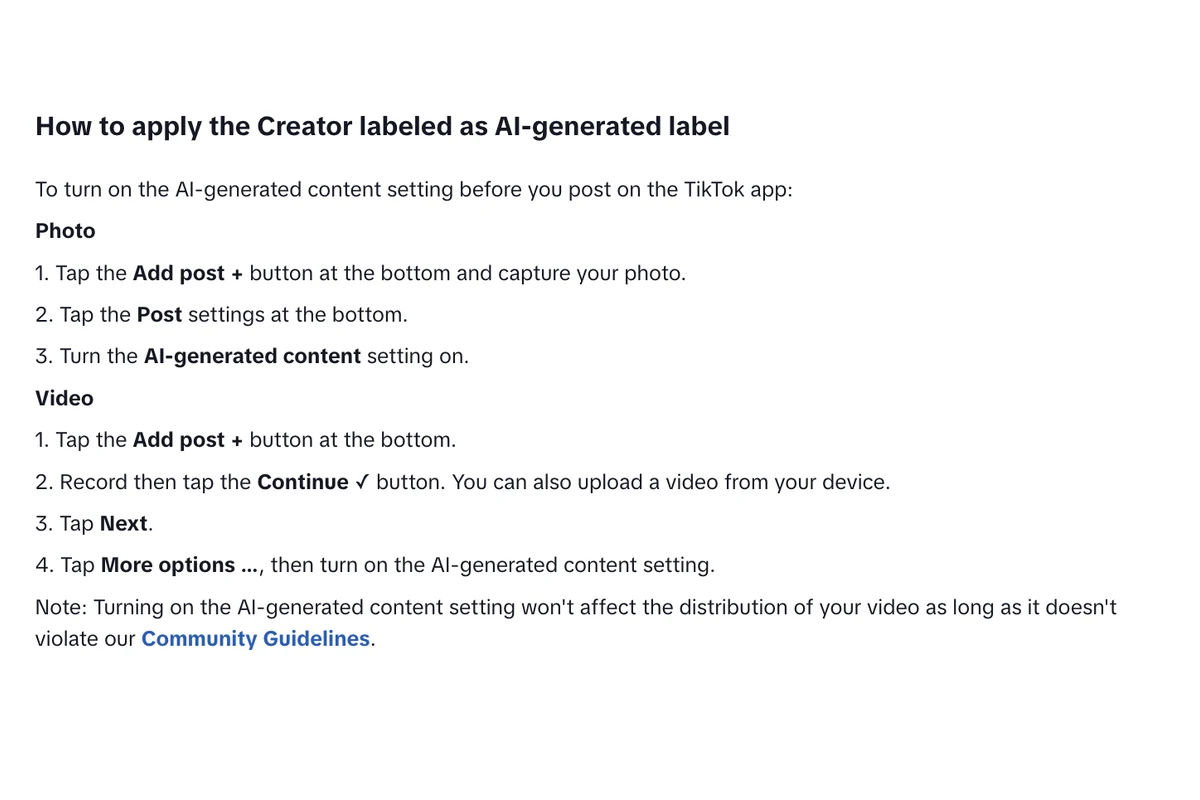
| Creator labeled as AI-generated | You, with the AI-generated content setting | TikTok does not say | Won't affect distribution if the post follows the Community Guidelines |
| Your own words, a hashtag sticker or a caption | You | Yes, it is your text | Nothing specific |
Why does my TikTok say AI-generated?
Because TikTok found a reason in the file, or in how the post was made. Its help page About AI-generated content describes the automatic label like this:
TikTok may automatically apply the "AI-generated" label to content we identify as completely generated or significantly edited with AI. This may happen when a creator uses TikTok AI effects or uploads AI-generated content that has Content Credentials attached, a technology from the Coalition for Content Provenance and Authenticity (C2PA).
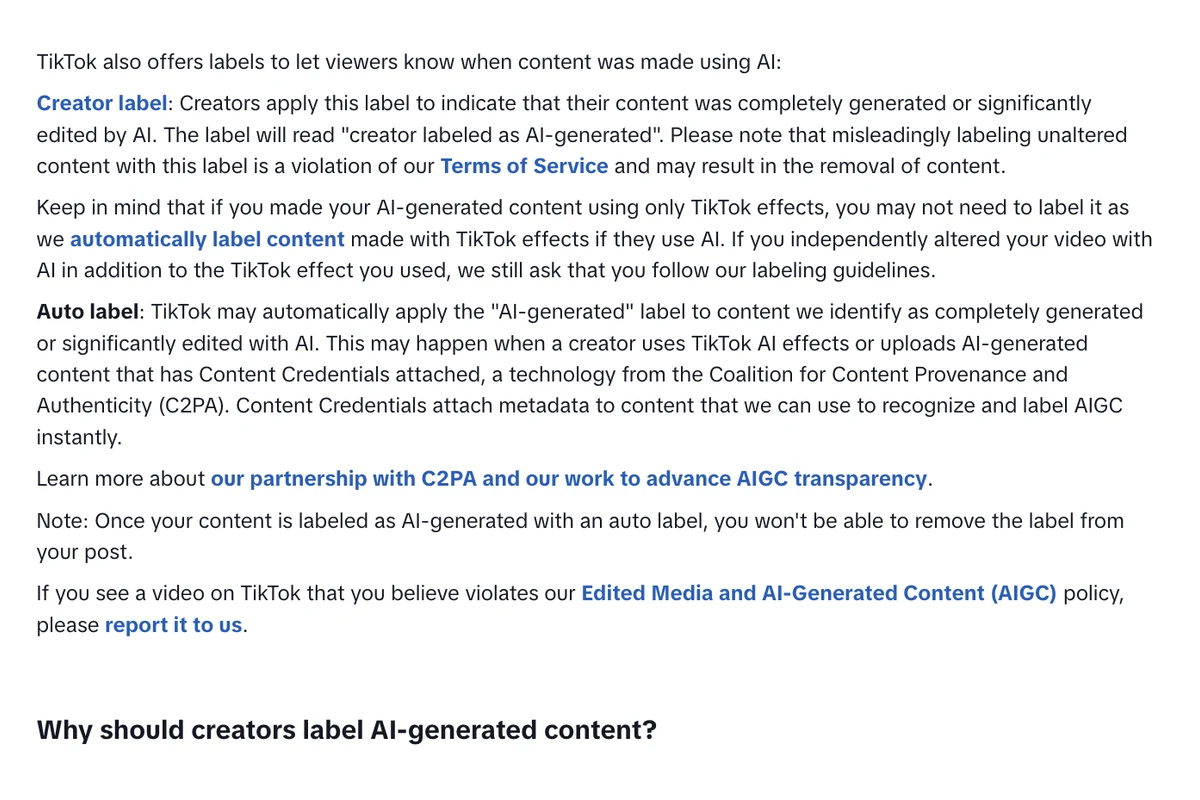
So there are two triggers named on the page. The first is TikTok's own tools: an AI effect inside the app labels itself. The second is a file that arrives already carrying Content Credentials, a signed record that AI tools write into what they make. TikTok announced it would start reading that record in May 2024, and described it plainly:
Content Credentials attach metadata to content, which we can use to instantly recognize and label AIGC. This capability started rolling out today on images and videos, and will be coming to audio-only content soon.
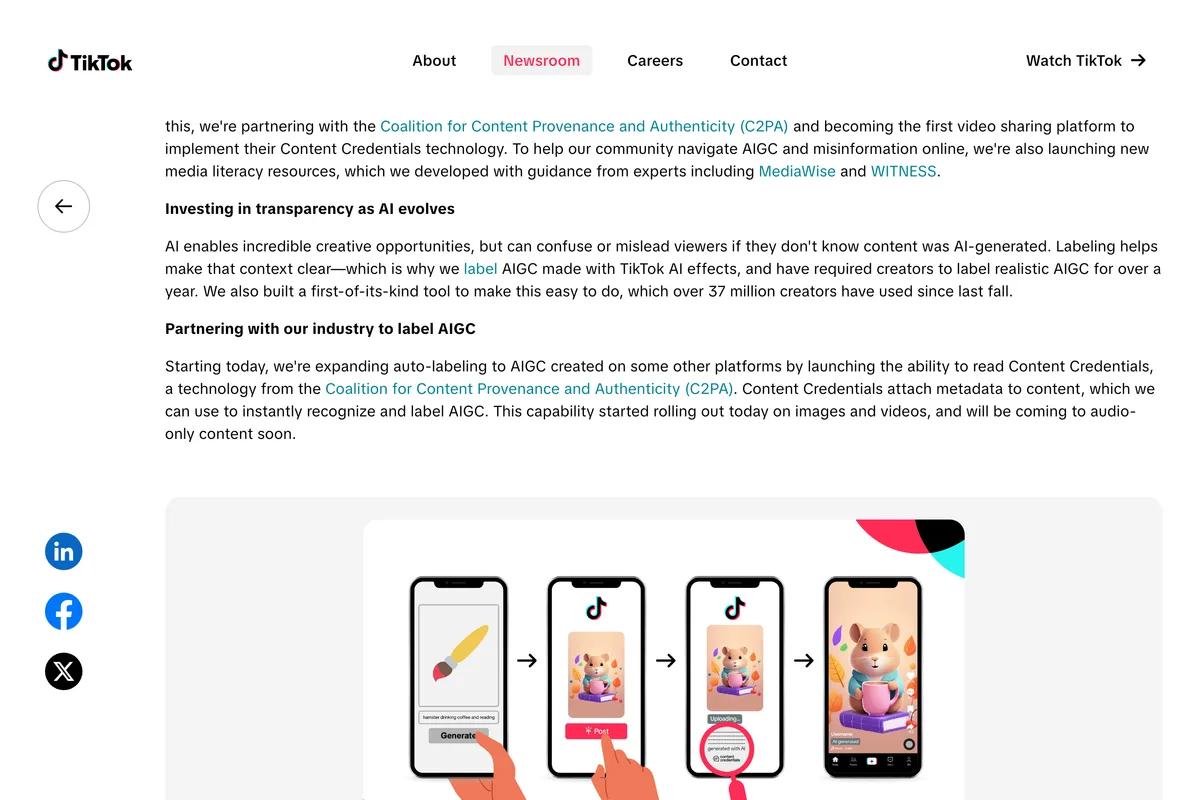
What is inside the file TikTok reads?
We looked. All 22 images Gemini returned for our headshot prompt tests, from all three of Google's image models, carried the record. In the one we took apart it sits in a single block of 6,344 bytes, and the readable parts of it name the C2PA standard and a chain of Google certificates that signed it. It is the same kind of record we found when we opened twelve Gemini files for why Instagram labels posts AI info, and Meta says it reads the same standard.
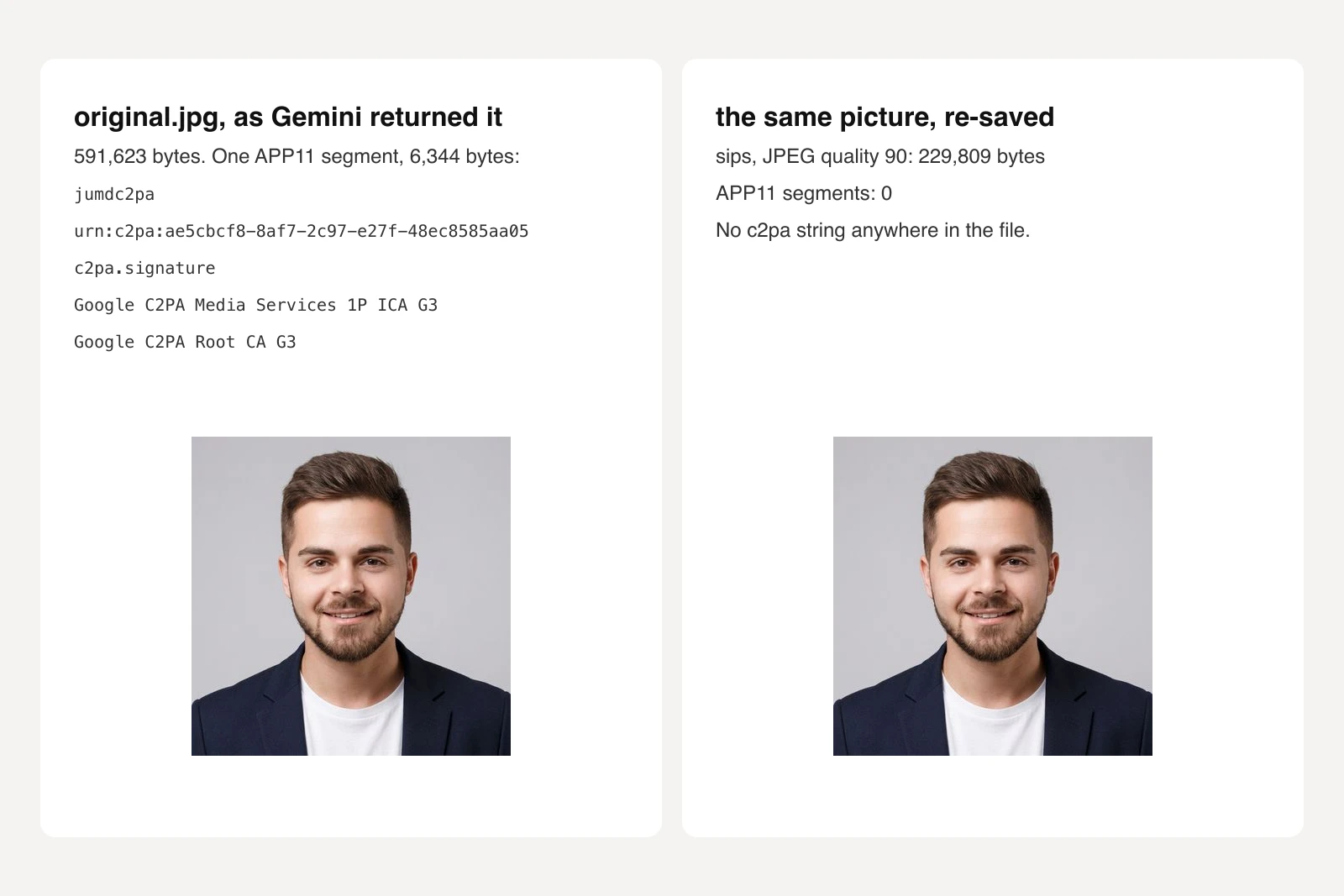
Then we handled that file seven ways, which is where it gets interesting for anyone who has seen a label appear on one post and not another:
| What we did to the file | Record still there? |
|---|---|
| Copied the file, nothing else | Yes |
| Saved again as JPEG, quality 90, in Apple's sips | No |
| Resized to 800 pixels in sips | No |
| Rotated 90 degrees in sips | No |
| Converted to PNG in sips | No |
| Saved as JPEG in sharp | No |
| Saved as JPEG in sharp with keep metadata switched on | No |
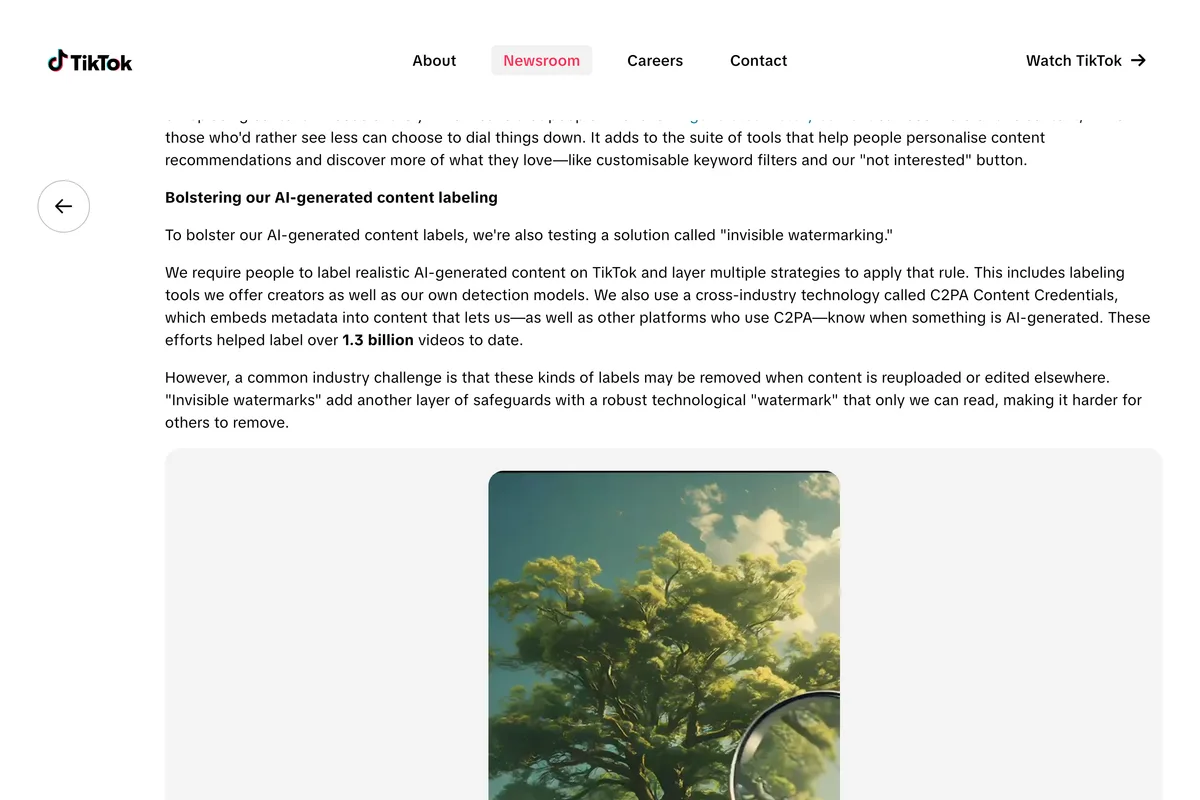
However, a common industry challenge is that these kinds of labels may be removed when content is reuploaded or edited elsewhere. "Invisible watermarks" add another layer of safeguards with a robust technological "watermark" that only we can read, making it harder for others to remove.
When do you have to label it yourself?
Whenever the content is realistic, whatever the file says. The help page is direct about it:
We also require creators to label all AI-generated content that contains realistic images, audio, and video, as explained in our Community Guidelines.
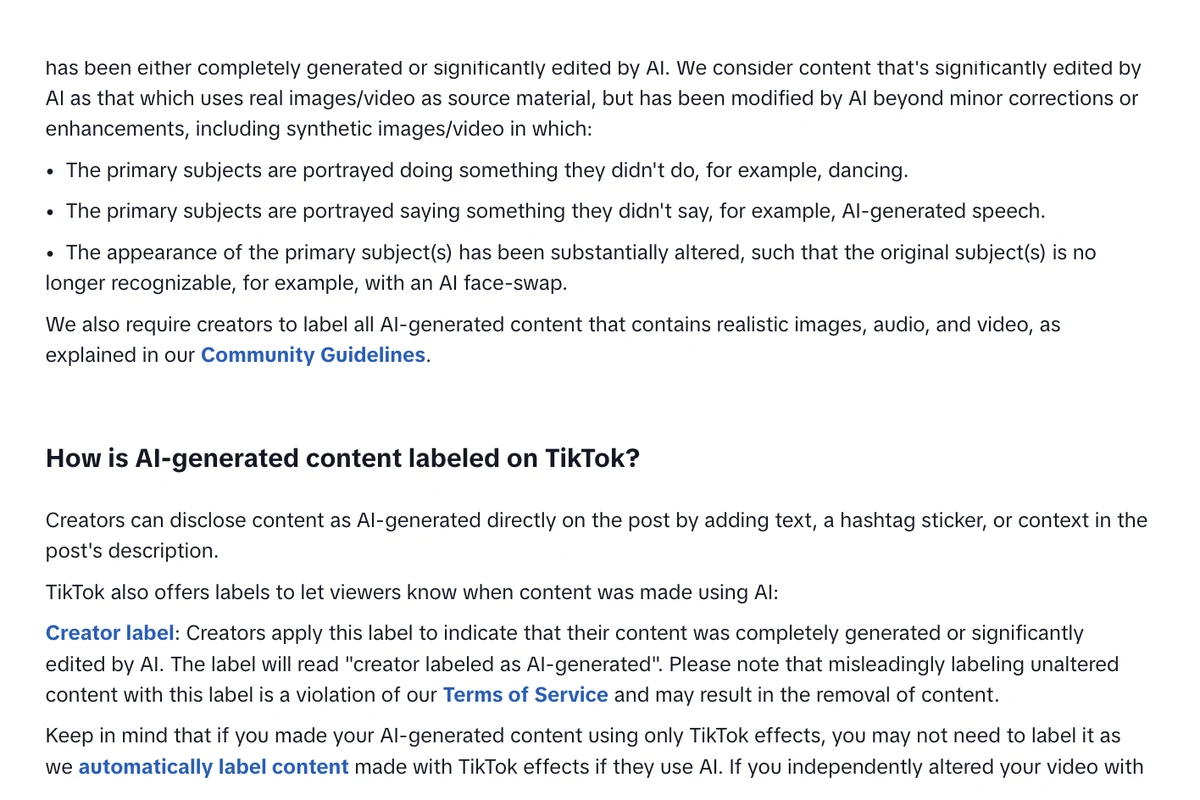
TikTok describes significantly edited as real source material modified by AI beyond minor corrections or enhancements, and gives three examples: the subject shown doing something they did not do, saying something they did not say, or altered until they are no longer recognisable. It encourages a label for anything completely generated or significantly edited, and requires one for anything realistic.
For a business, the practical reading is this. A lifestyle shot of your product that an AI model placed in a kitchen that does not exist is realistic AI-generated imagery, and you should turn the setting on. So is a video where AI makes it look as if a customer said something. A plainly illustrated graphic nobody would take for a photograph sits outside the realistic requirement, though TikTok still encourages a label. A background swap on a real photo is the grey zone: TikTok's line is minor corrections or enhancements, and it does not define where that ends. When unsure, label it; TikTok says the label you add yourself does not reduce distribution.

Can you remove the AI-generated label?
Not the automatic one. The note on TikTok's help page reads: once your content is labeled as AI-generated with an auto label, you won't be able to remove the label from your post.
The other direction has a rule too. TikTok warns that misleadingly labeling unaltered content with the creator label is a violation of its Terms of Service. The label is for AI content, not a hedge for anything that looks polished.
Does the AI-generated label hurt reach?
TikTok has made one promise, and it covers the label you add yourself:
Turning on the AI-generated content setting won't affect the distribution of your video as long as it doesn't violate our Community Guidelines.
It has not said the same about the automatic label, and one change points the other way: in November 2025 TikTok said it would start testing a control in Manage topics that lets people choose how much AI-generated content they see in their For You feed. A viewer who turns it down will, by design, see less of it. Nobody outside TikTok has published how that interacts with each kind of label, and we will not guess. What we can say is that labelling honestly costs nothing TikTok has admitted to, and being caught unlabelled can cost the post.
What to do if you post AI images on TikTok
- Turn on the AI-generated content setting for anything realistic that AI made or significantly edited. TikTok requires it and says it will not reduce distribution.
- Expect the automatic label on files straight from Gemini and other tools that write Content Credentials. It cannot be removed afterwards, so decide before posting.
- Do not use a re-save to hide it. The requirement to label realistic AI content does not depend on the file, and TikTok has its own detection and watermarks.
- Plainly illustrated graphics sit outside the realistic requirement, though the automatic label can still apply if the file carries the record.
- Never put a real person's likeness into an AI image without their permission. TikTok prohibits the likeness of adult private figures used without permission, even when labelled.
Frequently asked questions
Why does my TikTok say AI-generated?
TikTok applies the AI-generated label automatically when you use its AI effects, or when you upload a file carrying Content Credentials, a signed record from the C2PA standard that AI tools write into what they make. It also uses its own detection models. In our test every image Google's Gemini returned carried that record.
Can I remove the AI-generated label on TikTok?
Not the automatic one. TikTok's help centre says that once content is labeled as AI-generated with an auto label, you won't be able to remove the label from your post.
What is the difference between AI-generated and Creator labeled as AI-generated?
AI-generated is the label TikTok applies automatically. Creator labeled as AI-generated is the label you apply yourself with the AI-generated content setting before posting. TikTok says turning that setting on won't affect distribution as long as the post follows its Community Guidelines.
Do I have to label AI-generated content on TikTok?
Yes, if it is realistic. TikTok requires creators to label all AI-generated content that contains realistic images, audio and video. It also encourages labels for anything completely generated or significantly edited by AI, meaning changed beyond minor corrections or enhancements.
Does the AI-generated label reduce views on TikTok?
TikTok says the label you add yourself won't affect distribution if the post follows its Community Guidelines. It has made no such statement about the automatic label, and in November 2025 it began testing a setting that lets viewers choose how much AI-generated content they see. No outside study has measured the effect.
Why was my AI image labelled on one account but not another?
Usually because of the route the file took. The record TikTok reads survives a plain copy but, in our test, not a re-save: every re-encode we tried in Apple's sips and in the sharp library removed it. TikTok says such labels may be removed when content is reuploaded or edited, which is why it added invisible watermarks and its own detection.
Do Gemini images get labelled on TikTok?
They can be. All 22 images we generated with Gemini's three image models carried a C2PA record signed by Google, and TikTok says it reads that record to label AI content. We did not upload them to TikTok, so we have not seen the label applied ourselves.
How we researched this
- TikTok's statements were read on its own pages on 29 September 2026 and every one the article rests on is photographed in place. The help page on AI-generated content renders only after scripting, so it was photographed by hand in an ordinary Chrome window; the two newsroom posts were photographed by our capture script. TikTok edits its help centre without notice. If the wording you find differs, trust the page and tell us.
- The file test is small and exact. The 22 images are the ones we generated the same day through Google's developer API for our headshot prompt tests, saved exactly as they arrived. We searched each for a C2PA record and found one in every file. We then took one of them and handled it seven ways: a plain file copy, four operations in Apple's built-in sips tool (JPEG at quality 90, a resize, a rotation and a conversion to PNG), and two JPEG saves through the sharp library, one of them with its keep metadata option on.
- What we did not do is upload anything to TikTok. We can show you what is in the file and what TikTok says it reads. We cannot show you TikTok's system reading it, and the article does not claim to. TikTok also says it uses its own detection models and, since late 2025, invisible watermarks, so a file without the record is not a file TikTok cannot recognise.
- Nothing here is advice on how to avoid a label. TikTok requires realistic AI-generated content to be labelled whatever the file contains, and the article says so. It is an account of where the automatic label comes from.
Sources