Social media for construction companies: the progress post, the finished post and the site rules
A build takes months and produces a photograph every day, which makes construction the easiest trade to post for and the one that posts least. The progress post, the finished post, the crew post, the licence number that has to be in the caption, the client's address that must not be, and the drone shot everyone makes that gets nothing.
A build produces a photograph every day for months. Footings, frame, first fix, plaster, the day the kitchen goes in. No other trade has that much material, and no other trade posts less of it, because the person with the phone is also the person running the site. This article is about the three posts that come out of a live job without anybody stopping work, the two rules that keep them out of trouble, and the drone shot every building firm makes that gets nothing. It is written for the two to twenty person firm, not the developer with a marketing department, and it assumes the customer you want is deciding slowly and checking everything, because they are.
Our articles are still written by humans!
Get human written articles in your Google feed.
What the customer is doing when they look at your feed
Checking. A homeowner spending forty thousand on an extension has three quotes on the table and is looking for a reason to cross two of them off. They open the feed to answer three questions: are these people actually building things right now, have they built the thing I want, and who is going to be in my house for four months. A feed that answers all three at the shortlist stage wins jobs the quote alone would not. A feed that is a logo, a drone shot and a post from last spring answers none of them and quietly loses. That is the entire strategy, and it is the same one every local business has, stretched over a longer decision.
The progress post
One photograph a week from whichever site is furthest along, with one line saying what stage it is at. "Week six on the Elm Road extension: steels in, roof on by Friday." It does not need to be beautiful. It needs to be this week. A progress post says the firm is working, which is the first thing the checking customer wants to know, and it dates the feed, which a finished job photograph from two years ago does not. Photograph the work, not the street: the frame, the roof, the block, the steel, from inside the site looking at the job.

The finished post
The room, done, in daylight, with one line saying what it was. "Kitchen extension, Elm Road. Eleven weeks." This is the post that answers have you built the thing I want, and it is worth waiting for the light and wiping the worktop. Photograph the room from the doorway at the height a person stands, not from a drone and not from the garden. Where you can, pair it with the progress post from week one as a before and after, because a finished kitchen next to the footings it started from is the most persuasive thing a building firm can publish.


The crew post
One person, named, on site, doing their job. "Marek runs the Elm Road site. He will be the one you talk to." This is the post that answers who will be in my house, and it is the one building firms resist most, because it feels like it has nothing to do with building. It has everything to do with being hired. A homeowner letting a crew into their home for four months wants to have seen a face and a name, and a chain cannot make this post and you can. It also does more for hiring than any job advert.

The client's house, and the licence number
Two rules. First, the client's property is the subject of nearly every photograph you will take, and the client did not agree to be on Instagram when they agreed to a quote. Put a line in the contract that says you may photograph the work for your own marketing, that you will not show the street or the house number, and that they can say no to any picture. Then keep to it: photograph rooms and structure, never the front of the house, never anything with a name or an address, never the neighbours' garden. If a client says something nice about the job and you want to use it, the FTC's guidance is simple when nothing was given in return: ask, and post it as they said it.
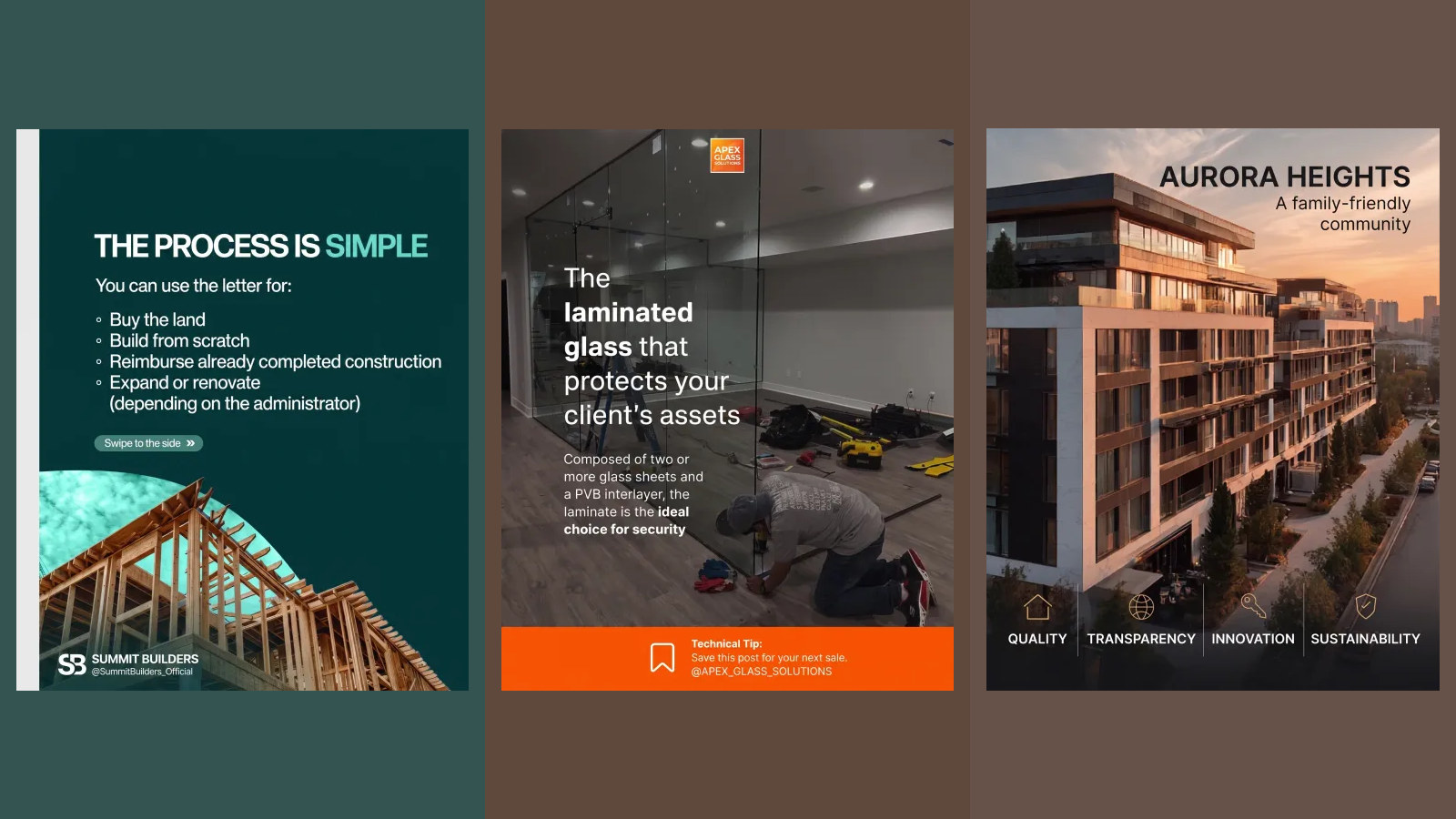
Second, the licence number. If your state requires it in advertising, a social media post is advertising. California states it plainly: a licensed contractor must include the licence number in all forms of advertising. Most states have some version of the rule and the details differ; your board's page is the one that governs you. The practical answer is the same everywhere: the number goes in your bio and in the footer of every post, the way the examples here carry it, and then you stop thinking about it.

The drone shot, and the other posts that get nothing
- The drone shot of a plot. Impressive to fly, empty to look at. It shows land. Post the frame going up on it instead, from the ground, next week.
- The logo on the hoarding. It says you have a hoarding.
- The safety poster. Health and safety matters on site and does nothing in a feed. If you want to show it, show the crew in their kit doing the job, which is the crew post.
- The stock render. If it is not your building, it is a lie in a small way, and the checking customer is looking precisely for your buildings.
- The supplier repost. The tile company's photograph of tiles. Post your tiler laying them.
- The holiday greeting. Post the site hours and the shutdown dates instead; that is the post a client with a live job actually wants.

Which platform, and how often
Instagram first, because it is where finished rooms are looked at and because Instagram posts now show in Google search, so a finished kitchen post can be found by somebody searching for kitchen extensions in your town. Facebook second, same posts, for the local groups where recommendations happen. Your Google Business Profile always, same posts again, because that is where the shortlist looks first. LinkedIn only if you do commercial work and want to be seen by architects and quantity surveyors, and then the same finished posts with a line about the contract. One post a week, from whichever site is furthest along, is enough: the goal is a feed that shows a year of building when somebody checks it, not an audience.
If writing the line under the photograph is the part that never happens on a Friday, that is what our product does from your website and past jobs, and what a chat model will do if you tell it which site is at what stage. The photograph is still yours to take, and on a building site it is the easiest photograph in the trades.
Frequently asked questions
What should a construction company post on social media?
Three posts: a progress photograph from a live site each week, the finished room in daylight when a job completes, and one named member of the crew. Together they answer what a checking customer wants to know: are you building now, have you built what I want, and who will be in my house.
Can a builder post photos of a client's house?
With a yes in the contract, and with the address, the street and the front of the house kept out. Photograph rooms and structure from inside the boundary. If the picture would work for an estate agent, it is the wrong picture.
Does a contractor need a licence number on social media posts?
In many states a post is advertising and the number is required. California requires it in all forms of advertising for every licensed contractor. Check your own board, and put the number in your bio and the footer of every post regardless.
Which social media platform is best for construction companies?
Instagram first, because finished rooms are looked at there and its posts now appear in Google search. Facebook for local groups, Google Business Profile always, and LinkedIn only for commercial work. The same posts everywhere, one a week.
How often should a construction company post?
Once a week from whichever site is furthest along, plus a finished post whenever a job completes. The aim is a feed that shows a year of real building when a shortlisted customer checks it.
How we researched this
- The advice here comes from two places. The author spent eight years working with property developers in London before this company, and the view of how a building firm is chosen, slowly, from a shortlist, by people checking everything, comes from that. The rest comes from what works for local businesses whose customers decide the same way, which is the category this product is built for. Construction differs from the other trades we have written for in that the job itself produces a photograph every day for months, and in that the client's property is the subject of nearly all of them.
- The licence number requirement quoted is California's, read from the Business and Professions Code on 18 August 2026 and linked below, because it is written in one sentence and applies to every licensed contractor. Most states have some version of it and yours may differ. Your state board's rule governs you, and this article is not legal advice.
- The drone shot and the other posts we tell you to skip are posts we have generated ourselves for building customers and watched do nothing. Being able to say which of our own drafts failed is the only qualification we claim for that list.
- The finished posts shown were made by our own product for building firms we invented, from briefs we wrote by hand. We sell the tool that made them and that is disclosed where it becomes relevant.
Sources